
Most of the app initiatives don’t fail because of a poor idea. They fail because the team doesn’t have the required abilities, experience, or development procedure. According to The Standish Group’s CHAOS Report, just 31% of software projects are considered successful, while 66% are partially or completely unsuccessful. Usually, the difference is in the professionals and procedures driving the project, not the technology itself.
Here are nine practical recommendations for building a mobile app development team that can lead to successful product launches.
A mobile app development team is a group of experts. They work together to design, build, test, publish, as well as manage a mobile app. Most people think only a few developers build an app. But it is not so. The success of the project depends on experts of different niches.
Typically, a mobile app development team consists; a project manager, UI/UX designer, iOS and Android developers, backend developers, QA engineers, and a business analyst. Each pro assists in creating an app that is functional, user-friendly, secure, and scalable.
The people who build your app are just as important as the technology. Even the greatest app idea can stall or go over budget if responsibilities are unclear.
Leanware’s research indicated that a significant percentage of app failures are due to team makeup rather than technological problems. The survey also finds that 77% of applications are often abandoned within three days after installation. This is due to poor onboarding, bugs, or performance problems. Balanced teams with clear duties can result in better user experience, less expensive errors, and long-term success.
Here’s exactly how to build a mobile app development team that delivers on time and holds up post-launch.

First, decide on your platform (iOS, Android, or both), target users, and must-have features. This ought to be the basis of every recruiting decision, not the other way around.
At a minimum, budget for a project manager, designer, developer, and QA engineer. Overlooking QA is among the most common and expensive errors teams make.
In-house teams give you more control; freelancers are good for small or short-term tasks. And if you need to move fast, a mobile app development company in the USA can staff a full team quickly.
Choose the devs who already launched applications in Swift, Kotlin, or Flutter. Their probability of making errors will be less. On the other hand, a first-timer can take weeks of a learning curve.
DesignRush reports that 73% of consumers remove applications because of bad navigation or interface issues. This is mainly due to a team that didn’t convey the design objective well enough while developing the app
Running tests in conjunction with development detects defects while they are still inexpensive to correct. However, the delay in QA can result in pricey fixes after software has been developed fully.
Someone has to be in authority of design approval, feature scope, and release time. Otherwise, little disputes will drag the whole project down.
Weekly or biweekly check-ins keep everyone honest about work and uncover scope creep before it becomes a big issue.
Operating systems will upgrade, people will report flaws, and app store standards will change. Your team’s work isn’t done at launch, so budget time and people for what comes next.
By following these processes regularly, a dedicated mobile app development team can often avoid the two most typical failure points: unclear ownership and missed testing.
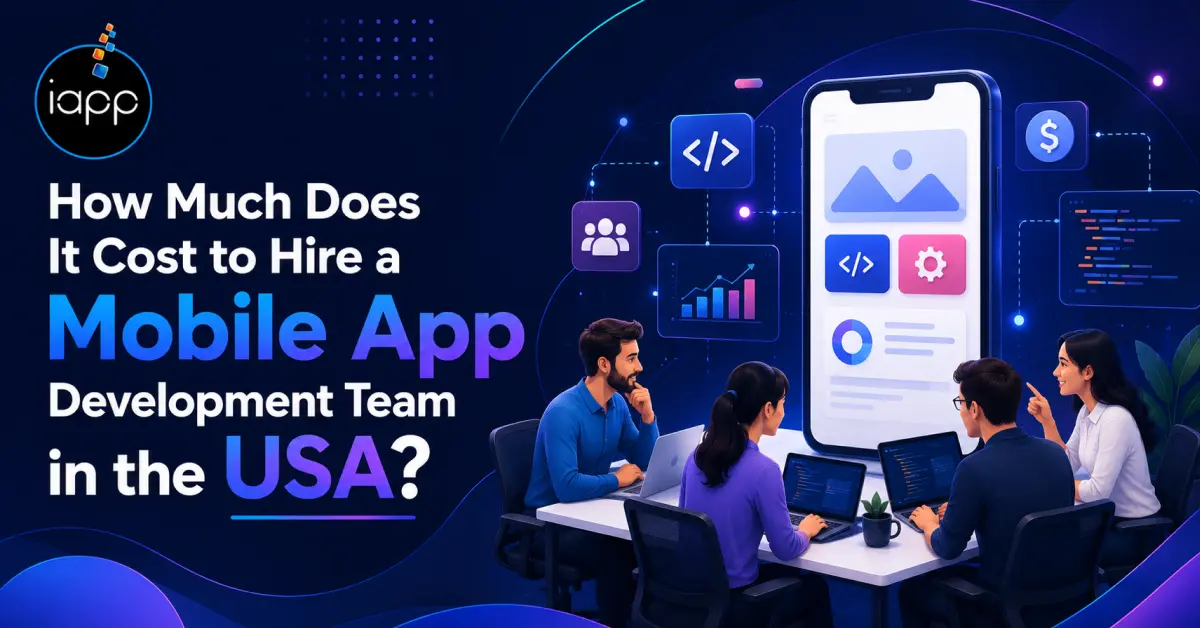
Costs fluctuate considerably with team size, location, and how sophisticated your software is. However, the median project range falls between $50,000 to $500,000. Monthly charges of hiring a basic 8 to 12 person team range between $45,000 and $75,000.
A plethora of businesses prefer to hire mobile app developers in the USA from an established agency. This eventually cut down the timeline because agencies already have vetted specialists.
An in-house team provides you greater day-to-day control. On the other hand, an agency gets you started quicker with expert professionals. Many expanding organizations choose the middle way. They go with in-house leadership and custom mobile app development services from an outside partner to get the job done.
The hybrid model means you can maintain strategic choices in-house and only bring in specialist expertise when the project requires it.
A great app concept becomes a great app only when the right professionals are structured to build it well. Follow the above mentioned nine steps to avoid the coordination difficulties that bury most projects.
Don’t want to hire at all? iApp Technologies provides a ready-made, dedicated mobile app development team for US and worldwide organizations. Contact us immediately to get your project started.
You will require at least a project manager, a UI/UX designer, a mobile developer, a backend developer, and a QA engineer. For larger projects, a business analyst or DevOps engineer is usually included.
Usually, a simple MVP is done by 4 to 6 persons. On the other hand, a full-featured platform app requires the cooperation of 8 to 12 professionals.
It all depends on your budget and how much control you want to have. An in-house solution provides you greater control. An agency gives you speed and a reduced upfront cost.
A basic MVP usually takes 3-4 months, and a full-featured app takes 6-9 months (depending on the scope and number of platforms you are targeting).
 Jagwinder Singh
Wait! Before you go…
Talk to our experts and turn your ideas into powerful digital solutions.


 Trusted by 1000+ businesses

Fill out the form and our team will get back to you shortly.