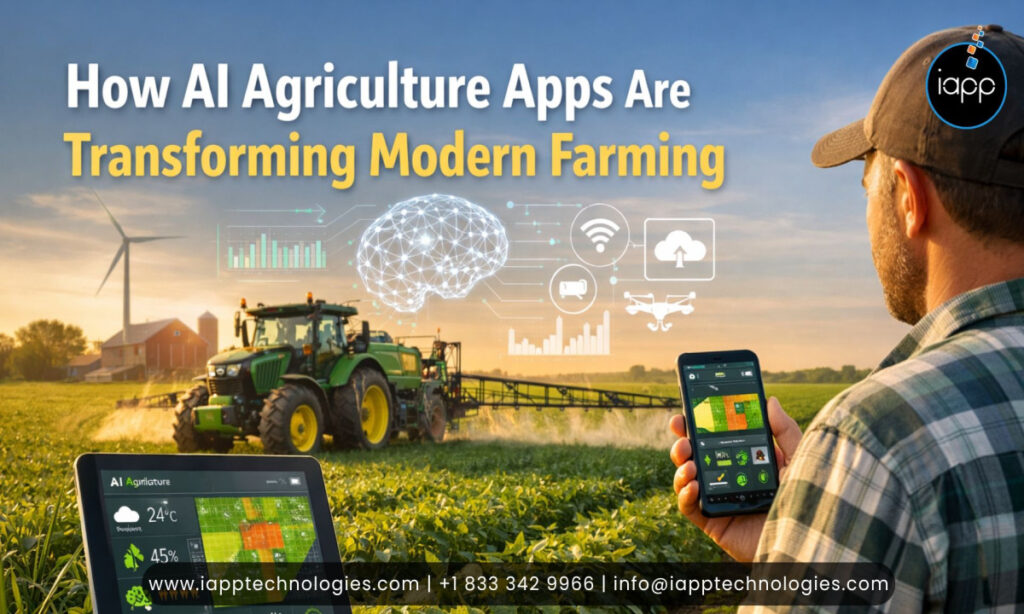
Modern farming is evolving faster than ever before. Climate uncertainty rising input costs labor shortages and changing market demands are pushing farmers to look beyond traditional methods. Today success in agriculture depends not only on experience but also on the ability to make timely data driven decisions. This is where AI powered agriculture apps are creating a meaningful shift.
At iApp Technologies we see AI agriculture apps as practical tools that support farmers in managing complexity, reducing risk and improving overall farm efficiency. These apps are not designed to replace farmers’ expertise but to strengthen it by providing accurate insights at the right time.
AI agriculture apps help transform farming from reactive operations into predictive and adaptive systems. They allow farmers to plan better act faster and stay resilient in an increasingly unpredictable environment.
Artificial intelligence has become a critical part of modern agriculture due to the volume of data generated across farms today. Weather data, soil reports, satellite imagery, machinery data and market signals are difficult to manage manually. AI helps connect these data points and turn them into useful recommendations.
Unlike traditional farm software that focuses on reporting past activity AI driven apps analyze patterns and predict future outcomes. This enables farmers to take preventive actions instead of reacting after losses occur.
Global leaders like John Deere have successfully integrated AI into precision farming. Their systems use machine learning and computer vision to identify crops, detect weeds and manage soil variability. This helps farmers reduce input costs while improving yield quality. Similarly The Climate Corporation (Bayer) leverages AI and weather forecasting to guide planting, input application and risk management decisions helping farms achieve more consistent outcomes even in unpredictable seasons.
With advancements in AI development services, agriculture apps are now capable of learning from each season. As more data is collected these systems improve accuracy and become more aligned with real farming conditions. This learning capability is what makes AI such a powerful enabler in modern farming.
In fact analysts predict that farms that adopt AI based decision systems could increase operational efficiency by up to 20–25% by 2030 helping the agricultural sector address rising global food demand and sustainability challenges.
The value of AI agriculture apps lies in their ability to deliver actionable insights not just data. These apps are built to support daily farming decisions without adding complexity.
Key features include predictive crop planning, disease detection using computer vision, automated weather alerts and input optimization recommendations. Many apps also use satellite imagery and sensors to monitor crop health in near real time.
Apps developed by an experienced mobile app development company focus heavily on usability. Farmers need clear instructions, simple dashboards and reliable performance especially in areas with limited connectivity. Offline functionality and smooth syncing are now standard expectations.
Another important feature is adaptability. AI models adjust based on seasonal changes, local soil conditions and historical outcomes making recommendations more accurate over time. Integration of technologies such as hybrid app development ensures farmers can access these insights on any device whether in the office or in the field.
Efficiency in farming today means doing more with fewer resources while reducing uncertainty. AI agriculture apps help achieve this by optimizing key farming processes.
One major benefit is cost control. AI driven recommendations help farmers apply water fertilizers and pesticides only where and when needed. This reduces waste and protects crop health without compromising yield potential.
Labor productivity also improves. With limited availability of skilled labor AI powered automation reduces the need for manual monitoring. Farmers can focus on critical tasks instead of repetitive checks.
Quality consistency is another major advantage. By identifying stress indicators and disease risks early AI apps help maintain consistent crop quality. This consistency supports better pricing and reduces losses caused by late intervention. Technologies like John Deere’s AI enabled equipment or Bayer’s Climate Corporation platform demonstrate how actionable insights can directly improve decision making on the ground.
Additionally AI apps now integrate predictive analytics that consider market trends, export demand and price fluctuations. This allows farmers to align their production strategies with market signals ultimately improving profitability. Over time these improvements lead to more predictable outcomes and stronger operational stability.
The future of AI agriculture apps is closely linked to innovation in AI technologies. Generative AI development is enabling smarter interactions within apps such as scenario modeling and decision simulations. Farmers can compare different actions before implementing them reducing guesswork.
Hybrid app development is also playing a major role. It allows agriculture apps to work seamlessly across devices while supporting offline use in remote farming areas. This ensures uninterrupted access to critical features during field operations.
Market momentum continues to grow. The global AI in agriculture market was valued at approximately USD 5.9 billion in 2025 and is expected to reach around USD 9.55 billion by 2030 reflecting strong growth as farms increasingly adopt intelligent technologies to optimize operations and decision making driven by climate challenges population growth and the need for sustainable food production.
As AI continues to mature agriculture apps will move beyond monitoring and become intelligent decision support platforms. By combining AI with farm level data, predictive models and actionable alerts farmers can make informed choices that balance productivity quality and profitability.
At iApp Technologies, we focus on understanding your business before suggesting any solution. Every farming operation has different challenges, goals and working methods and we respect that.
When you contact us you explain your business, your farming process and the problems you are facing. Our team listens carefully and reviews your requirements in detail.
After understanding your needs we analyze your challenges, available data and technical scope. Based on this analysis we suggest the most suitable AI powered solution that addresses your specific problems. Whether it’s predictive crop planning, input optimization or market alignment our goal is to deliver a practical easy to use agriculture app that truly supports your operations and grows with your business.
Our approach ensures that the app is not just a software product but a long term tool that adapts to seasonal changes, operational scale and evolving market dynamics.
AI agriculture apps are becoming a foundational part of modern farming. Their role is expanding from optional tools to essential systems that support resilience and long term sustainability.
As climate volatility and cost pressure increase farms that rely on predictive insights will be better prepared to adapt. AI helps reduce uncertainty and supports smarter planning across seasons.
In the future AI agriculture apps will not only optimize operations but also strengthen decision confidence. Farms that adopt intelligent systems early will be better positioned to stay competitive and profitable.
What are AI agriculture apps mainly used for?
AI agriculture apps are used for crop monitoring, yield forecasting disease detection, input optimization and decision support across farming operations.
Are AI agriculture apps suitable for small farms?
Yes many AI agriculture apps can be scaled to support small and medium sized farms by focusing on specific high impact use cases.
Do AI agriculture apps require constant internet access?
Most modern apps are designed to work with limited connectivity and support offline usage with delayed data syncing.
How quickly can farmers see results after using AI apps?
Initial benefits such as cost reduction and early risk detection can appear within one season while long term gains improve over time.
Can you build a custom AI agriculture app?
Yes, iApp Technologies develops custom AI agriculture apps based on your business needs, challenges and long term goals.
 Jagwinder Singh
Wait! Before you go…
Talk to our experts and turn your ideas into powerful digital solutions.


 Trusted by 1000+ businesses

Fill out the form and our team will get back to you shortly.