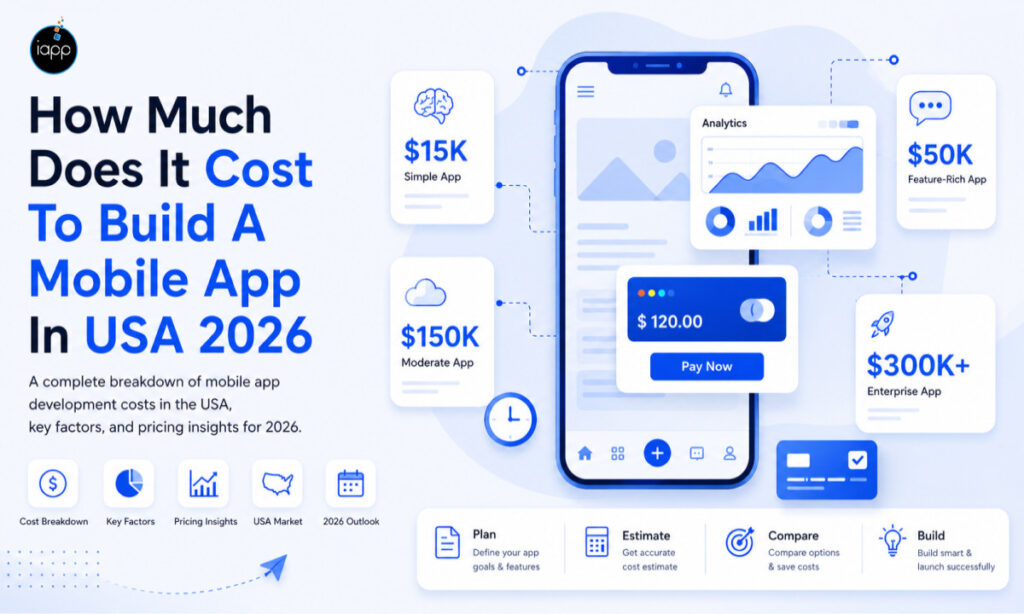
Planning to build a mobile app for your business this year? The first question on your mind is probably about budget. But the fact is mobile app development costs in the USA vary widely because every app is built differently. According to a report of Mordor Intelligence, the global mobile application market is estimated to reach $391.3 billion in 2026. This clearly indicates that nearly every type of business is investing in apps, making it crucial to establish the right budget from the outset.
A simple booking app and a fully AI-powered marketplace app will never land in the same price bracket, and that gap is exactly what we will break down here. Whether you’re a startup entrepreneur or a big firm searching for a mobile app development company in the USA to bring your vision to life, this blog post provides you with real data, genuine reasoning, and a clear path forward.
Here is the quick glance before we get into details.
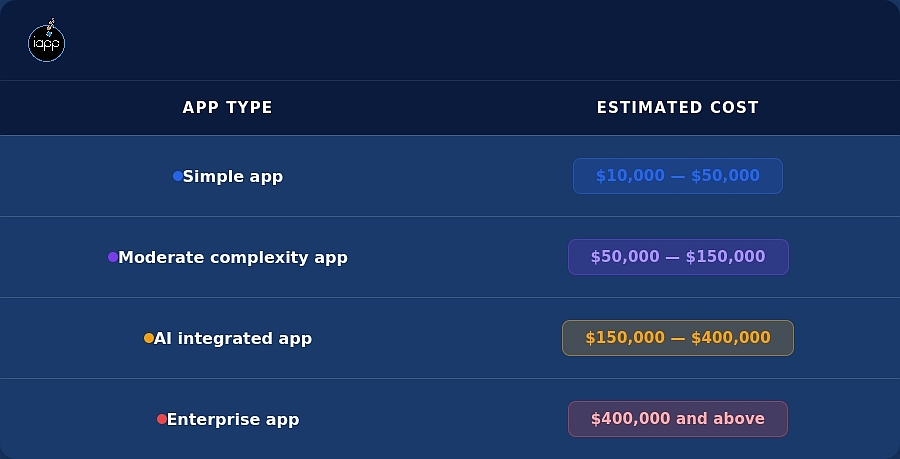
These statistics are in accordance with what most US based development teams are quoting in 2026. Fortune Business Insights highlighted that the global mobile application market will grow to approx. $1,017.18 billion by 2034. This shows that a significant amount of capital is flowing into app development worldwide.
Also read- How to Build a Marketplace App in 2026 From Idea to Launch
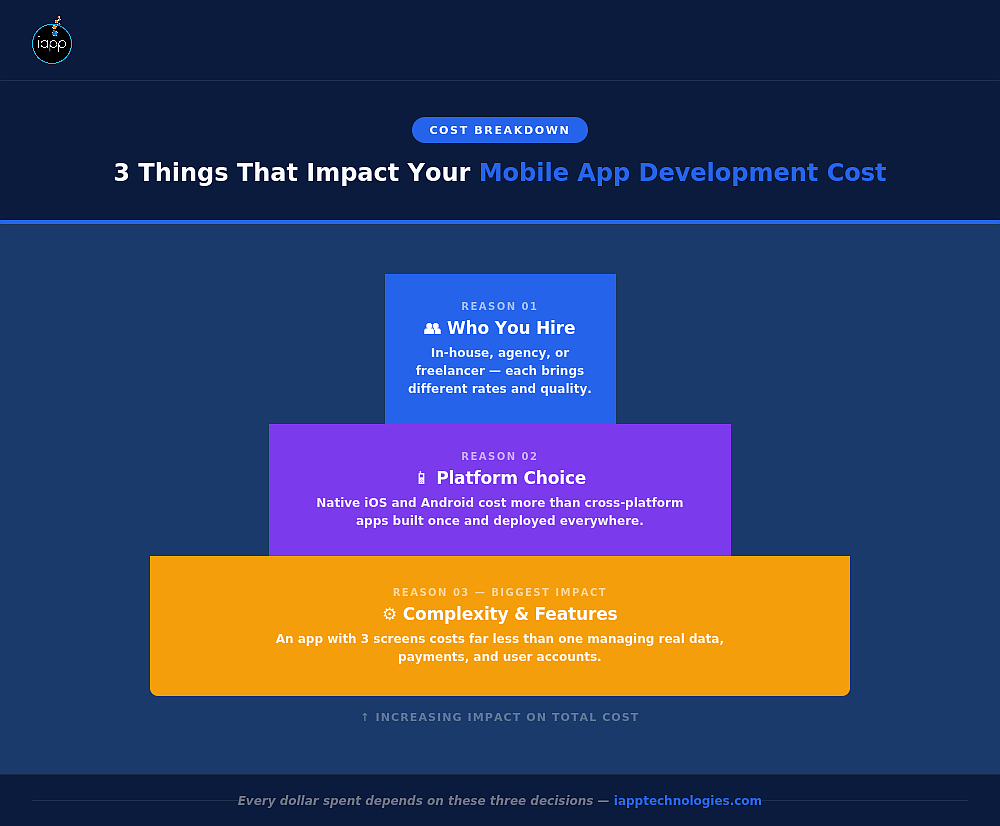
There are three key reasons behind the wide price range of mobile app development cost USA:
First, who you appoint to develop an app matters. An in-house team, a dedicated agency, or a freelancer. They all come with different rates and timelines as well as quality levels.
Second, the platform you pick plays a significant role. Native apps developed individually for iOS and Android are more expensive than cross-platform apps that are built once and deployed everywhere.
Third, and most important, your budget is driven by complexity and feature count. An app with 3 displays and no backend will always be cheaper than an app managing real data, payments, and user accounts.
Some features are easy builds, while others demand considerable engineering effort. Features that usually drive up your budget includes:
User identification and login systems
Payment gateway integration,
Real-time chat
GPS and location monitoring
Push notifications
AI-based personalization or suggestions
Each one adds development hours, testing cycles, and sometimes license expenses for third-party tools.
One prevalent misperception is that a larger app always costs more. But, in reality, complexity is more important than the number of screens. Even the basic utility business app, with fewer screens overall, is far more affordable than a business app with backend functionality.
Furthermore, more complex databases and matching logic are required for marketplaces or two-sided apps where you are linking buyers and vendors. Enterprise solutions go one level up. They often require specific security layers and compliance features, as well as integration with current enterprise software.
Also read- Building a Dating App Like Tinder: A Complete Guide
An MVP (minimum viable product) is a way to test your concept with real people before you actually spend an extensive amount of hard-earned money. The average cost of an MVP in the USA is between $15,000 – $60,000 depending on the number of key features you add.
Generally, these applications have user accounts and content management as well as basic integrations. The costs vary considerably, ranging from $50,000 – $120,000 for a finished, dependable app that reflects your business in the best way.
Marketplace applications require proper functionality on both sides, real-time updates, and error-free payment processing. Depending on the number of user roles and workflows you require, the overall price might vary from $100,000 – $250,000.
Enterprise apps have to be designed with significant security, scalability, and compatibility with legacy systems in mind. These initiatives generally start at $300,000 and may cost up to $500,000 for major organizations.
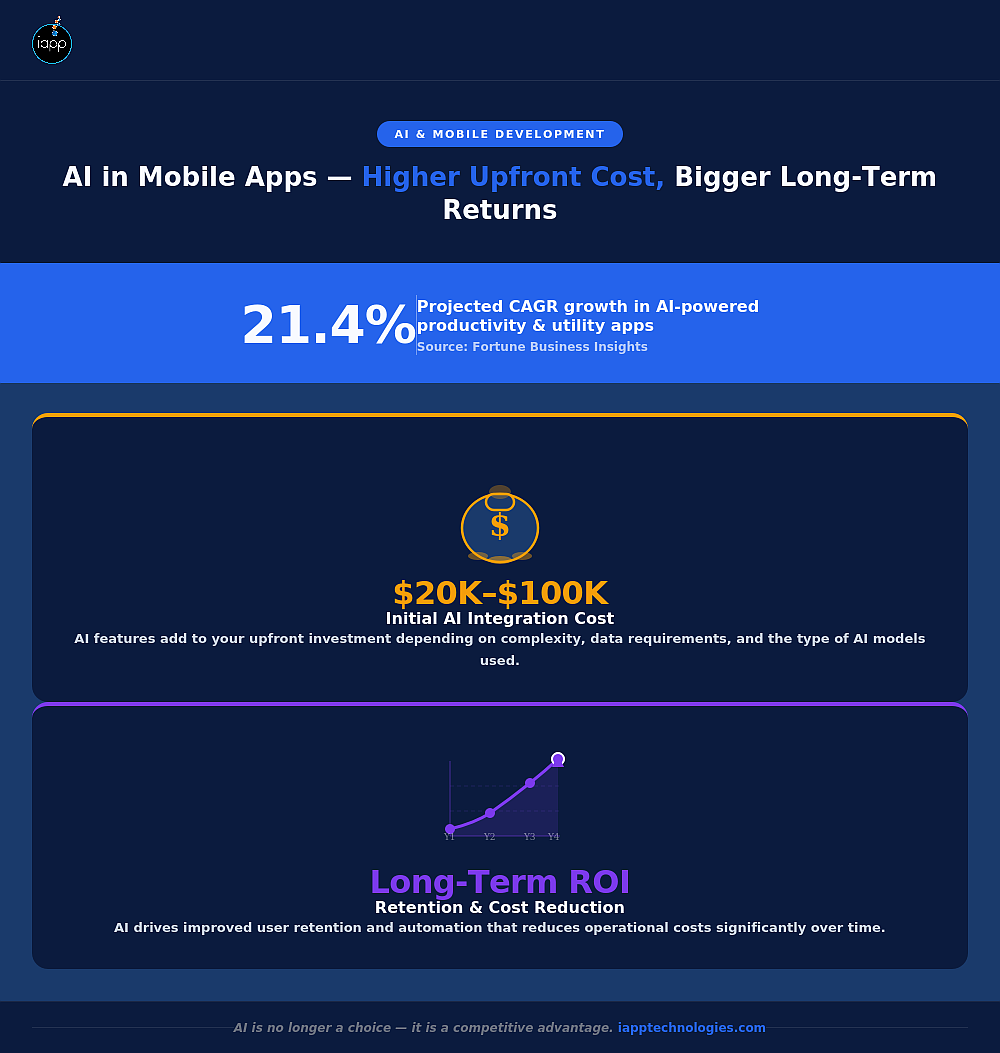
AI is no longer a choice for many firms, and the figures tell the story. The AI features are most common in the productivity and utility applications market, which is predicted to increase at a CAGR of 21.4 percent in the coming years, according to Fortune Business Insights.
AI integration in mobile app development adds to your initial cost (about $20,000 to $100,000 depending on the product), but it also provides long-term benefits with improved user retention and automation that decreases operational expenses over time.
The price is crucial, but the partner you pick to develop and launch your business app also matters a lot. Therefore, choose a company with a solid portfolio in your niche, a modern tech stack, and clear pricing (without any hidden costs). The service provider should also support and maintain the product after launch.
If you are seeking custom mobile app development services in the USA and want a company that has the right technical knowledge and straightforward communication, then iApp Technologies is worth considering.
We have expertise creating applications in healthcare, retail, logistics, finance, and more. Our experts are well versed in integrating AI with traditional applications. We collaborate with startups testing their initial MVPs and also with established companies rolling out enterprise-grade systems. Ready to obtain a precise quote for your project? The iApp Technologies team is happy to guide you through a no-obligation consultation.
Generally, the simple apps cost $10,000, whereas enterprise-level apps (with AI and complex integrations) can go over $40,000. Many small to mid-sized businesses spend around $50,000 to $150,000 for a solid, feature-rich app.
A basic app can take approx. 2 to 4 months, while complex or enterprise apps often take 8 to 9 months. The actual timelines depend on feature scope, complexity of design, and testing requirements.
Yes, but the increase is related to the feature’s complexity. Simple chatbots add modest costs, while advanced recommendation engines or predictive analytics can add several thousands of dollars.
Cross-platform development is generally inexpensive. Because there is only one codebase that serves iOS as well as Android. On the other hand, native development is a bit costly but often delivers better performance for complex apps.
 Jagwinder Singh
Wait! Before you go…
Talk to our experts and turn your ideas into powerful digital solutions.


 Trusted by 1000+ businesses

Fill out the form and our team will get back to you shortly.