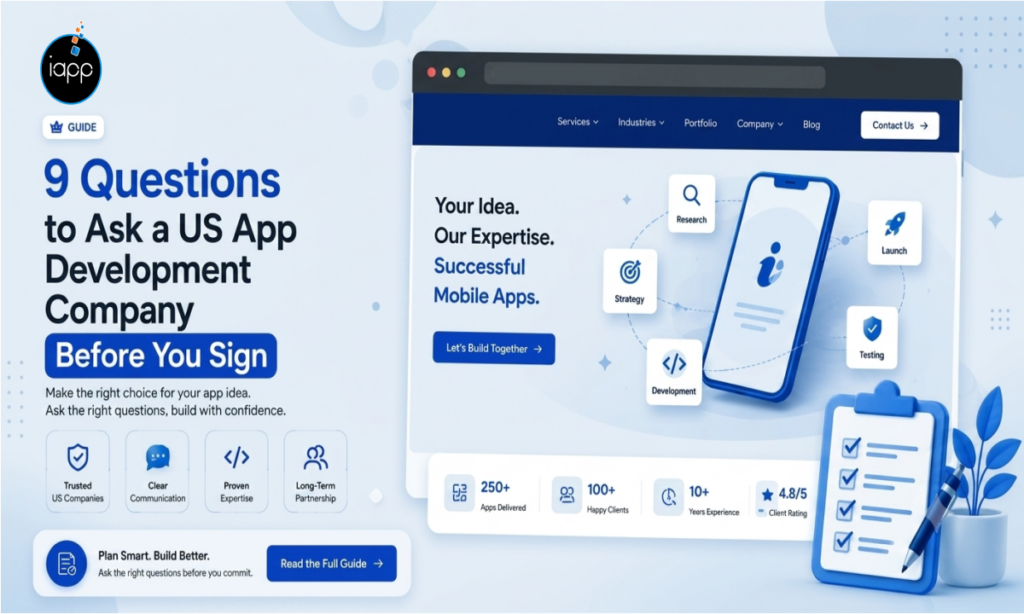
The contract you sign is only as strong as the questions you ask before it. The right questions reveal whether the app development company in the USA you are evaluating is a real product partner or a vendor who will not be in contact after launch. In this guide, we will discuss 9 imperative questions, along with answers that will assist you choose the right vendor. By the end of this guide, you’ll learn how to evaluate potential vendors, compare their answers, and confidently select the right mobile app development company for your project.
The U.S. mobile application market was worth about $53.71 billion in 2023 and is projected to grow at a 14% CAGR through 2030, reaching roughly $131 billion, according to Grand View Research. As more businesses invest in mobile apps, the number of development companies continues to grow. This eventually makes it harder to choose the right partner. That’s why evaluating a company’s experience, development procedure, technical expertise, and communication is essential to avoid expensive mistakes and build a successful app.
Can You Show Relevant Experience and Case Studies in My Industry?
What Is Your Development Process and How Will You Manage My Project?
How Do You Price Projects and Structure Payments?
Who Will Own the Code, IP, and App Store Accounts?
How Do You Handle Security and US Compliance Requirements?
How Do You Ensure Quality, Testing, and App Performance?
How Will the App Scale as My User Base Grows?
What Post-Launch Support and Maintenance Do You Offer?
What Are the Red Flags to Watch For in Their Answers?
Now, let’s take a closer look at each question and understand why it matters.
Ask for proof, not solely promises. A credible partner will hand over mobile app case studies with live App Store and Google Play links. This way you can download the work and read real user ratings.
Look for:
Vertical relevance. Ask vendors whether they have experience with apps in your industry. Every different industry has distinct requirements and compliance. For instance, a fintech app needs proof of secure payments, while a healthcare app needs to comply with regulations like HIPAA.
Live apps you can open. Screenshots of apps can be fake. So, always ask for working apps with real public ratings.
Third-party validation. Don’t rely on the testimonials published on the vendor’s own website. Instead, check the reviews on credible third-party platforms like Clutch and GoodFirms.
Complexity match. A vendor good at making simple apps may not be ready for real-time data, video, or offline sync. So, you need to verify examples of projects with similar features, scale, or technical complexity to ensure the company can successfully deliver your app.
A clear process is a crucial predictor of timely and budget-friendly app delivery. In case a company cannot clearly explain how they manage projects, it’s a red flag. McKinsey and the University of Oxford found that large IT projects run on average 45% over budget and deliver 56% less value than predicted, with 17% going so badly they threaten the company itself.
A strong mobile app development process has these traits:
A named methodology. A professional app development company should use Agile or Scrum to deliver the project in planned stages, share regular updates, and let you review completed work before development continues.
A real point of contact. The dependable vendor assigns you a dedicated project manager who keeps you updated and serves as your primary point of contact.
Defined tooling. A reliable company should use pro project management and communication tools to keep your project organized as well as transparent. For instance, Jira or Linear for tasks, Slack for daily updates, and Figma for design layout.
A discovery phase. A genuine developer partner begins with a discovery and planning phase to clearly define your project’s scope, budget, and timeline before development starts.
Always ask your vendor to discuss your project timeline in weeks tied to features, not vague phases. A professional partner will also name the exact stack. For reference, the technologies we use at iApp Technologies include Swift and SwiftUI for iOS, Kotlin for Android, and React Native or Flutter for cross-platform builds. We also offer no code solution and don’t follow a one-size-fits-all approach.
Get the pricing model and the payment schedule in writing before beginning anything. The goal is transparency: you should see how an estimate is built from features, complexity, and hours and how change requests get billed.
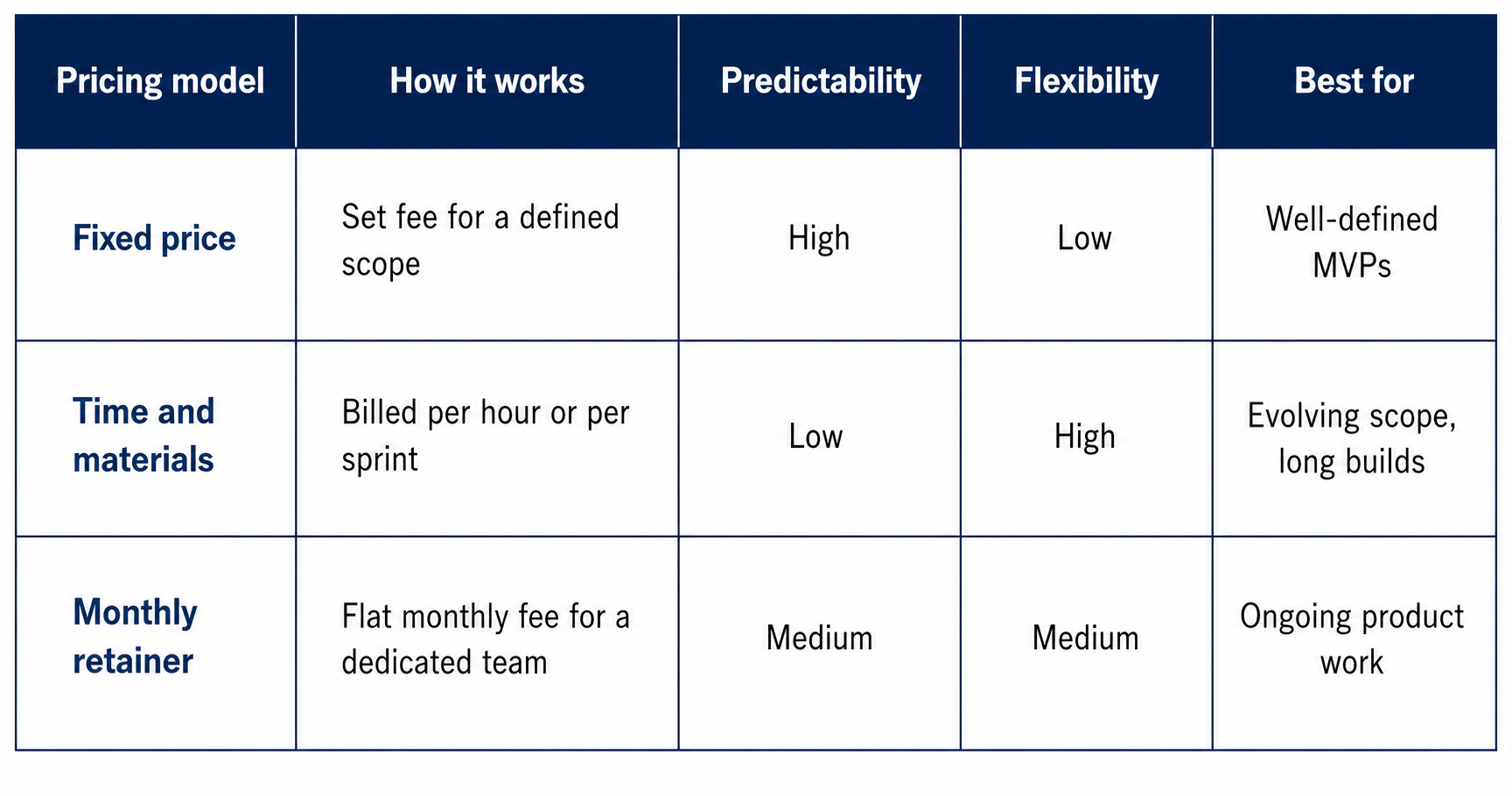
A healthy milestone payment schedule for a typical build spreads risk across the project rather than front-loading it:
Discovery and scope: 20%
UI/UX design sign-off: 20%
Build phase one: 20%
Build phase two: 20%
Launch and handover: 20%
A demand for 100% upfront is a red flag. So is a single lump-sum number with no breakdown by feature or phase.
You should own 100% of the source code, the intellectual property, and the Apple as well as Google accounts. Don’t forget to be written into the contract before work begins. This is non-negotiable.
Confirm these points:
Full IP assignment. Make sure your contract clearly states that you own the app’s source code, design files, and all intellectual property after the development process is complete.
A mutual NDA. Ask the company to sign an NDA before sharing confidential and sensitive business information or your app development idea.
Third-party and open-source clarity. Know which libraries are used and under what license, so nothing bounds your ownership later.
Account ownership. The App Store and Play Console accounts should be in your name, not the vendor’s.
This is not just paperwork. They have real business and legal consequences. A clean IP (intellectual property) assignment is exactly what investors and acquirers check during due diligence. Without clear ownership, funding or acquisition deals can be delayed or even fail.
Compliance is where US teams earn their rate and where many cheaper vendors quietly cut corners. The right partner asks what data your app collects before quoting, because the answer changes the overall structure.
Ask how they handle the rules that apply to your specific industry:
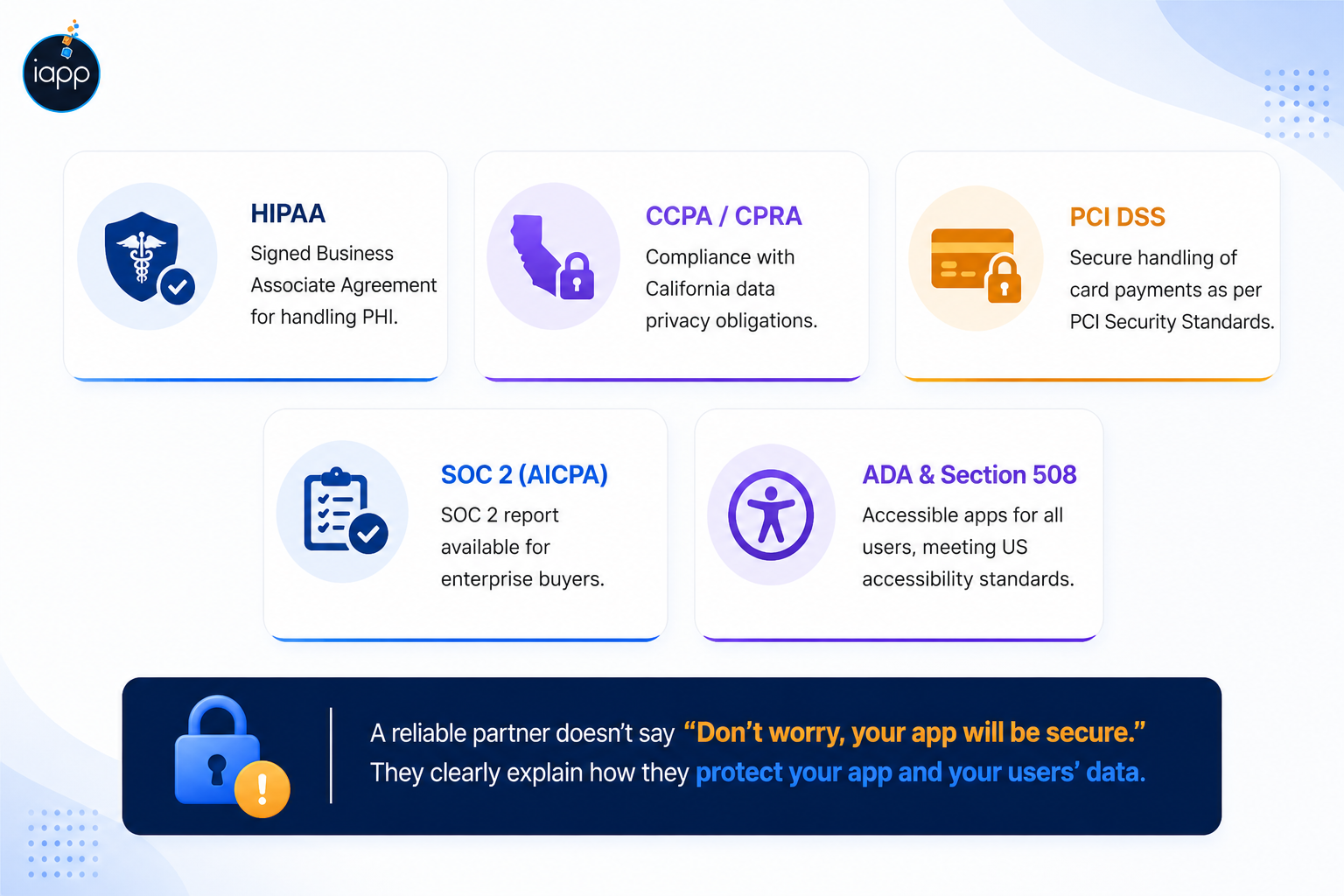
HIPAA: Any app that stores or shares protected health information needs a signed Business Associate Agreement. See the HHS guidance.
CCPA / CPRA: Collecting data on California residents triggers obligations under the California Attorney General’s rules.
PCI DSS: Handling card payments requires compliance with the PCI Security Standards Council.
SOC 2 (AICPA). Enterprise buyers often require a SOC 2 report from your vendor.
ADA and Section 508: Make sure the company builds accessible apps that everyone can use, including people with disabilities, while meeting US accessibility requirements.
When you ask a development company about security, and they say, “Don’t worry, your app will be secure,” it means there is some issue. The reliable partner clearly explains the process of how they will protect your app and your users’ data.
For instance, they will tell you about encryption in transit or at rest, secure authentication, and protected APIs. A healthcare app must have a BAA in place before any patient data is touched, and a consumer app collecting personal data should have a clear CCPA stance. Full-cycle mobile app development services build security as well as compliance into the app from day one rather than fixing it after a breach.
Bugs and slow load times can affect the apps at a very initial point after launch. So, quality assurance cannot be overlooked. The numbers are surprising; AppsFlyer reports that more than one in two apps installed are uninstalled within 30 days. Also, Google Think says that 53% of mobile visits are abandoned when a page takes longer than three seconds to load.
A serious QA answer includes:
A layered test process. The company should follow a structured testing procedure to verify and fix issues before your app goes live.
A device and OS matrix. Testing should be done across real iPhone and Android devices and OS versions, not solely on one simulator.
Access to builds. A reliable company should share working versions of your app throughout development so you can review progress and provide feedback before launch.
A bug warranty. In case bugs are discovered shortly after the app launches, the company should fix them for free of cost during an agreed warranty period.
Your app may launch small, but a successful one has to handle growth without a costly rebuild. Ask how the architecture supports more users, features, and data over time.
Look for:
Scalable architecture. Ask the vendor whether the app is built using a modular or microservices architecture. This will make it easy to add new features, support more users, and scale your business without significant redevelopment.
Cloud experience. Choose a company with experience using trusted cloud platforms like AWS, Google Cloud, or Azure and database optimization.
Performance planning. Verify how the company uses load testing to prepare for high user traffic. Also, verify how they handle caching to improve app speed and a content delivery network (CDN) to deliver content faster during high traffic.
Real proof. Choose a team that can describe how they handled a launch-day surge or a high-traffic event.
In a US mobile market growing at double-digit rates every year, planning for scale is planning for the success you are paying to create.
Launch is just the beginning of the real work, not the finish line. Operating systems require updates, security issues emerge, and users request new features with time. So, upkeep is the larger part of the bill. Industry research from IEEE and Gartner consistently puts software upkeep at roughly 60% to 80% of total lifecycle cost.
Clarify before signing:
Warranty period. What is covered for free after launch and for how long?
Ongoing support. Retainer or hourly options with a dedicated developer available.
Response times. A defined SLA for urgent issues, not best effort.
Store upkeep. Help with OS update patches and App Store or Play resubmissions.
In our experience reviewing rescue projects at iApp Technologies, the single most reliable predictor of a failed build was a vendor who quoted a firm price before asking what data the app would handle. Specifics and trade-offs signal a trusted partner. On the other hand, scripted reassurance signals a vendor who will likely increase your budget and timeline later. So, the biggest clue is not the price tag; it is how a team answers when you push for detail.
Use this table to score the answers you get on each call.
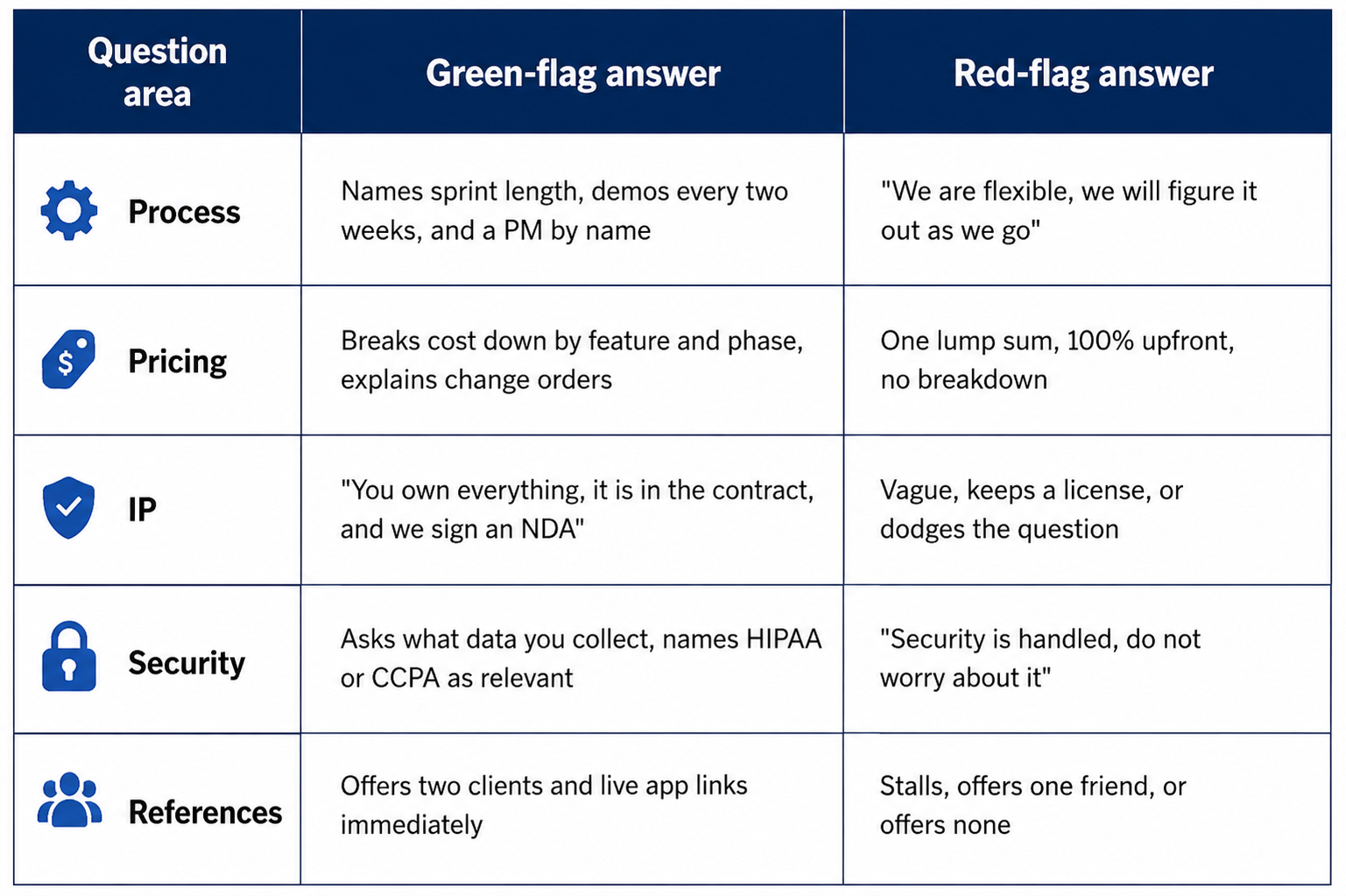
A simple way to use this: ask all 9 questions, mark each answer green, yellow, or red. Do not choose a vendor with red flags in IP, security, or references. Those three are the ones that cost the most to fix later. The strongest app development company in the USA won’t be offended by detailed questions. They provide clear, evidence-backed answers to keep transparency and a smoother partnership, not a threat.
The right questions protect your six-figure investment and separate true partners from vendors who often disappear after launch. Before signing an app development contract, verify experience, understand pricing, secure IP ownership, confirm compliance, evaluate testing practices, and review maintenance terms. These questions assist in alleviating cost overruns and improve project success.
Ready to get clear answers? Book a scoped consultation with iApp Technologies. We will walk you through the process, timeline, IP ownership, and pricing on the first call. Our mobile app development services are designed to build scalable, high-quality apps that support your business growth.
If you want to hire an app development company in the USA, inquire about their portfolio, development process, price, project schedule, source code rights, security standards, compliance knowledge, and post-launch assistance. Request customer references and look at real applications to see the company’s experience.
Most app development businesses in the USA charge from $100 to $250 per hour based on expertise and the complexity of the project. A business software with specific connectors or compliance needs is far more expensive than a simple MVP. Always seek a thorough estimate with defined milestones for payment.
If there is a need for robust communication, legal protection, and adherence to regulations, the best option would be a US-based app development partner. Offshore teams are a great option to save money, and some of them also offer good project management & smooth communication. The appropriate pick will rely on your budget, the complexity of the project, and company objectives.
At the end of development you should own the source code, the intellectual property, the design files, and the app store accounts. Get an IP assignment or a work-for-hire clause included in your contract before you start the project to prevent ownership issues down the road.
Look for real applications, verifiable customer feedback, case studies, and independent evaluations on sites like Clutch or GoodFirms. The company should be open about the price and willing to explain how it develops the products.
Be careful of organizations that want full payment before the work is done, won’t provide references, give unclear schedules, or avoid addressing source code ownership. Poor communication, unreasonable pricing, and imprecise contracts are all signs of possible project dangers.
A basic mobile app takes around 2-4 months, while a more complicated one will take 6-12 months or more. The timing will rely on features, integrations, design complexity, testing, and client input throughout development.
Yes. Good app development vendors provide regular test builds throughout the development process. This way you may look at features, report bugs, and propose changes before the final software hits the App Store or Google Play.
Post-launch support includes bug repairs, security upgrades, performance monitoring, operating system compatibility updates, and continuing maintenance. Ask about the warranty length, response times, and long-term support alternatives before signing a contract.
A good app development business should use safe coding principles, data encryption, secured APIs, and robust authentication mechanisms. They should also be aware of compliance regulations such as HIPAA, PCI DSS, CCPA/CPRA, and ADA depending on your company.
An app development contract should include a defined project scope, timeframe, payment milestones, ownership of intellectual property, a confidentiality clause, a warranty, maintenance, and a mechanism for modification requests. A thorough agreement will avoid any misunderstandings throughout the process.
Yes, however, it’s simpler if you have the source code / documentation / cloud accounts / app store accounts. These ownership rights should be in your contract before development starts to prevent vendor lock-in.
 Jagwinder Singh
Wait! Before you go…
Talk to our experts and turn your ideas into powerful digital solutions.


 Trusted by 1000+ businesses

Fill out the form and our team will get back to you shortly.