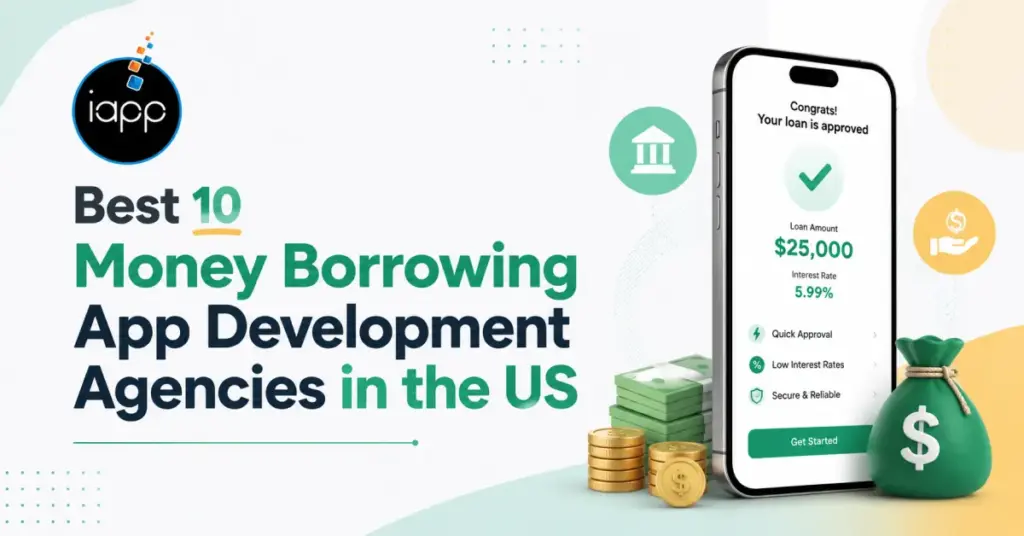
Millions of Americans are now applying for loans on their phone instead of at a bank office. The app they use determines whether that loan feels secure or sketchy. K. B. V.: The global digital lending platform market reached $12.63 billion in 2025 and is expected to reach $69.10 billion by 2032. That growth means picking the right money borrowing app development company USA businesses trust is no longer optional.
It makes the difference between a compliant product and a costly rebuild. This guide breaks down what these companies actually do, why the right partner matters, and which ten agencies are worth a serious look.
A money borrowing app development company in the USA provides software that enables consumers to apply for loans, get approved, and pay back online. The companies provide one platform that combines credit scoring, KYC checks, and payment integrations. Most are also handling compliance work, such as PCI DSS and AML screening. Because a lending app handles sensitive financial data at every stage.
The right loan app development company USA decides whether your platform launches on time and passes regulatory review. A team that treats compliance as an afterthought can block your app store listing or a banking partnership later. Look for proven production apps, not just polished case study slides. Ask how many of their lending builds are still live and processing real transactions today.
Here are ten agencies building loan, lending, and borrowing platforms for American businesses right now.
A money borrowing app development agency in the USA with over 5,000 successful digital deliveries and 70+ in-house developers. It builds AI-driven lending and crypto wallet apps alongside broader fintech products and is Clutch and Google top-rated.
A loan app development services USA provider with 15+ years building fintech products and $3B in financial transactions processed through its apps.
An ISO 27001-certified money lending app development company with 350+ solutions delivered across 50+ countries and a 97% client retention rate.
A borrowing app development company with 12+ years of experience and 1,280+ projects delivered for finance and banking clients.
A fintech app development company in the USA is rated 4.9/5 on Clutch across 67 verified reviews, with clients including SAP and Square.
A lending app development company USA focused on regulated banking and trading platforms, holding an 87% client retention rate.
A neobank specialist with a 5.0/5 Clutch rating across all five-star reviews and a white-label lending core called FintechCore.
Ranked #11 globally on the Clutch 1000 in 2025. The certified team of this ISO 27001- and ISO 9001- company focuses on compliance-heavy lending products.
It is equipped with a blockchain-focused developer with clients like Nestle and Land Rover. The company rated 4.8/5 on Clutch across 42 reviews.
Operating since 1989 with 750+ specialists and 45+ certified project managers, ideal for legacy lending platform modernization.
Every agency on this list brings something different, from compliance depth to blockchain expertise to fast MVP timelines. Match your choice to your regulatory scope and launch timeline rather than the flashiest portfolio.
iApp Technologies stands out among these firms. It combines AI-driven development with hands-on fintech experience and round-the-clock support. In case you are ready to build a secure, scalable lending platform, reach out to iApp Technologies today. Our team will give free project consultation.
They build the full loan cycle: application, credit checks, approval, disbursement, and repayment, wrapped in secure, compliant software.
Costs typically range from $25,000 for a simple MVP to $350,000 or more for a fully regulated lending platform.
An unregulated MVP takes about two to four months, while a compliant app with KYC/AML can take four to nine months.
Common choices include Flutter, React Native, Node.js, Python, AWS, and third-party APIs like Plaid and Stripe.
Yes, AI helps automate credit scoring, fraud detection, and personalized loan recommendations for faster decisions.
Biometric login, encryption at rest and in transit, secure APIs, and fraud monitoring are standard requirements.
A strong one will, integrating KYC/AML screening and PCI DSS controls directly into the system architecture.
Specialized teams already know the regulatory landmines and typically deliver a compliant product faster than an in-house team starting from zero.
 Jagwinder Singh
Wait! Before you go…
Talk to our experts and turn your ideas into powerful digital solutions.


 Trusted by 1000+ businesses

Fill out the form and our team will get back to you shortly.