AI in transportation involves the use of data, machine learning, and automation to enhance routing, fleet operations, logistics, safety, and customer service. In Trimble’s 2026 Transportation Pulse Report, 44% of shippers were already using AI for transportation. This adoption proves AI is no longer an experimental endeavor. It is assisting real planning and operational choices.
Here we will shed light on the primary advantages, realistic use cases, real-world examples, and development concerns. Read the whole article and see how artificial intelligence may help you improve your transportation operations or product.
AI in transportation implies the use of software to evaluate transportation data. It also aids with operational decisions. AI can handle GPS, traffic, vehicle, freight, and customer data much faster than manual methods.
The technology can support several transportation functions, including
Common technologies entail machine learning, computer vision, optimization algorithms, and NLP.
For example, machine learning may be used to forecast delays using previous traffic data. Then an optimization system can recommend an alternate route. This makes artificial intelligence in transportation valuable for operational software and customer-facing apps.
AI in logistics and transportation can alleviate manual work and improve planning. It also assists teams in making swift operational decisions. However, the actual results depend on data quality, system design, and the specific use case.
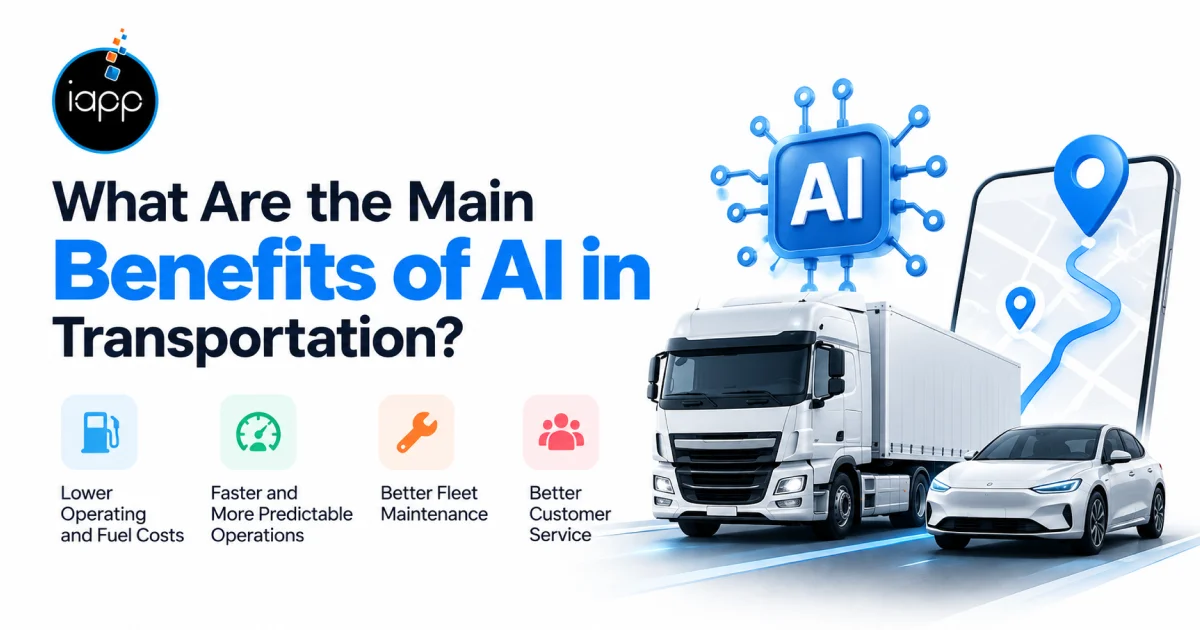
Key benefits include:
Route optimization may cut down unnecessary mileage and idle time. Fleet teams may also identify inefficient use of vehicles. A delivery platform, for example, may consider many routes before assigning a driver. It can also update the route as the traffic situation changes.
AI may evaluate real-time data and warn of delays earlier. This enables dispatch teams to intervene before minor difficulties escalate into significant interruptions.
Better Fleet Maintenance
AI can analyze vehicle diagnostics and upkeep records. It can recognize patterns that imply a higher failure risk. This eventually can help fleet teams plan upkeep before a vehicle causes an unforeseen disruption.
AI is able to answer about cargo, booking, route, and status. It can also send automatic warnings when route conditions change. The U.S. Department of Transportation has identified AI use in safety, efficiency, traffic management, asset maintenance, and passenger services.
The best AI transportation use cases address specific operational challenges. They link transportation data to a decision, forecast, or automated action.
AI for route optimization takes into account traffic, delivery windows, vehicle capacity, and road conditions. The logistics platform is able to compute many routes. It then suggests the alternative that fits the needed constraints.
AI in fleet management integrates GPS, telematics, vehicle diagnostics, and driver data. A fleet dashboard may identify excessive fuel use, prolonged idle times, upkeep risks, or route deviations.
This feature analyzes data from vehicles to predict when maintenance may be required. For example, a fleet platform may track engine data and service history. It then sends alerts when certain indicators go over predefined levels.
AI is able to take into account past journeys, locations, time periods, and external variables to predict demand. Such projections might be used by a ride-hailing company to aid driver distribution during projected demand peaks.
AI can assess camera, sensor, and traffic data for incidents and congestion. Many systems use AI for traffic signals, incident detection, crash-risk analysis, and transportation decision support.
AI assistants can answer basic queries regarding reservations, cargo status, routes, and projected arrival times. They can have conversations with backend APIs, not just static responses.
These are some of the practical AI transportation applications. Each one of them connects AI with an existing transportation workflow.
The following real deployments prove that AI in transportation industry applications extend beyond autonomous cars.
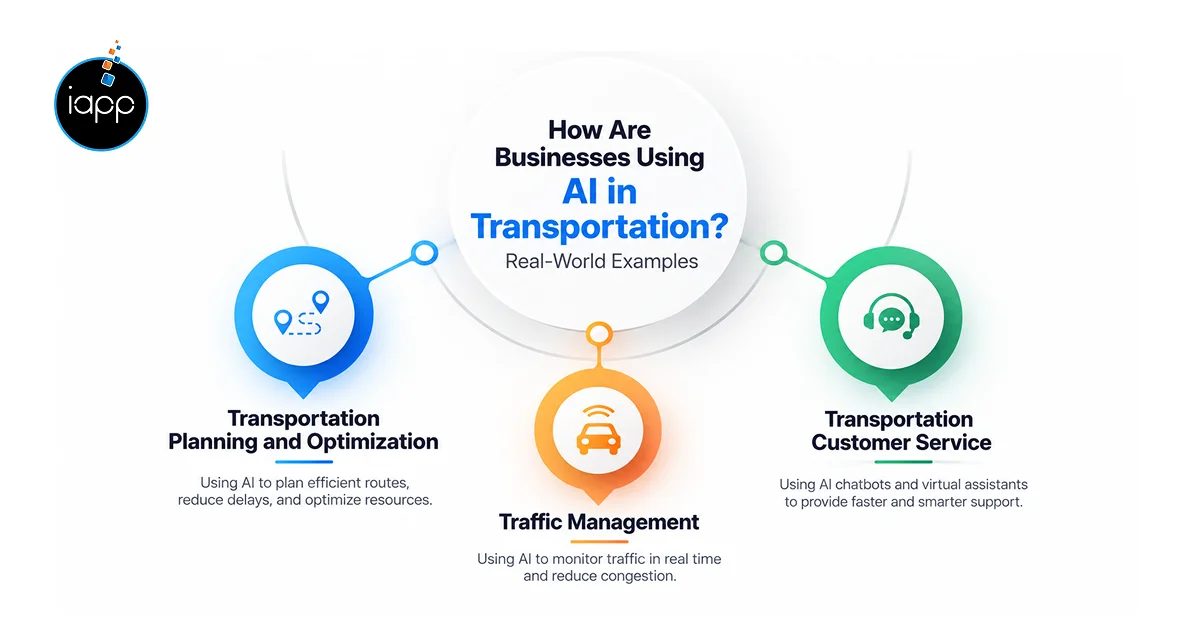
Businesses are using AI in transportation industry apps to improve route planning. Here is one real example. UPS, a major U.S.-based package delivery and logistics company, uses its ORION system. It optimizes delivery routes by analyzing a plethora of factors. Some of them are delivery requirements, traffic, and driver constraints.
The Tennessee Department of Transportation is using an AI-based decision support system (AI-DSS) to evaluate traffic and incident data on Tennessee’s I-24 corridor.
The system gives suggestions for changeable speed limits, traveler information, lane control operations, and traffic signal timing. This example highlights how AI transportation applications can aid transportation agencies to adjust to changing highway conditions.
One such example in the real world is Lyft. The firm collaborated with Anthropic to use AI for customer support. This partnership helps to answer thousands of consumer concerns on a daily basis. Lyft has seen an 87% decrease in average customer-service resolution time using AI. Meanwhile, human agents continued managing difficult concerns like safety and fraud.
It highlights how customer service may be helped by AI transportation applications without taking away human supervision.
AI transportation software adds prediction, pattern analysis, and decision support to traditional software functions.
| Capability | Traditional Software | AI-Powered Software |
|---|---|---|
| Route planning | Fixed rules | Data-based recommendations |
| Fleet monitoring | Status tracking | Risk and pattern detection |
| Maintenance | Scheduled service | Failure-risk prediction |
| Dispatch | Manual assignment | Demand-based recommendations |
| Customer support | FAQs and agents | AI-assisted responses |
| Reporting | Historical reports | Predictive insights |
| Alerts | Predefined triggers | Pattern-based alerts |
The difference is not simply adding an AI model. The app must link data, models, APIs, workflows, and user actions. That distinction is imperative when you think about how to build AI-powered transportation solutions for a new product.
AI works best as a connected part of a transportation product. It can sit behind mobile devices, online dashboards, APIs, and backend operations.
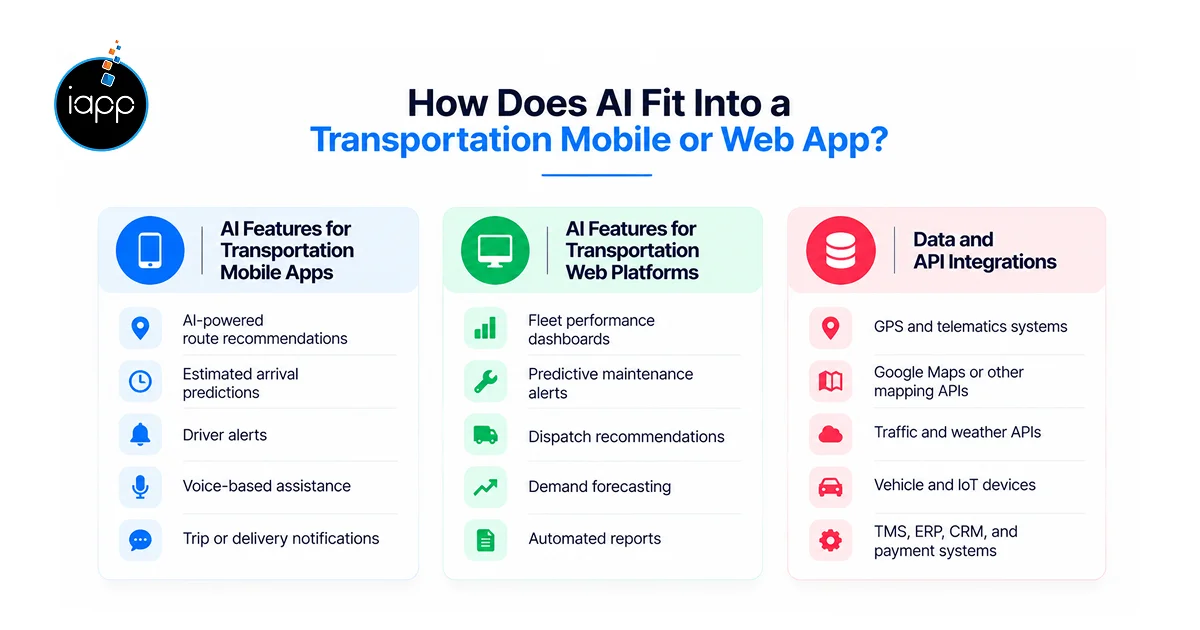
A driver or customer application can include:
A driver app may use an API to receive route suggestions. The backend may analyze real traffic data before providing the advised route.
A web platform can provide:
This makes AI transportation app development useful for both internal teams and external customers.
A transportation application may connect with:
The app can use REST APIs, webhooks, databases, and real-time event streams. However, the exact architecture depends on the product as well as data requirements.
Businesses asking how to build an AI transportation app should begin with the operational problem. The AI model must solve that issue in lieu of becoming the starting point.
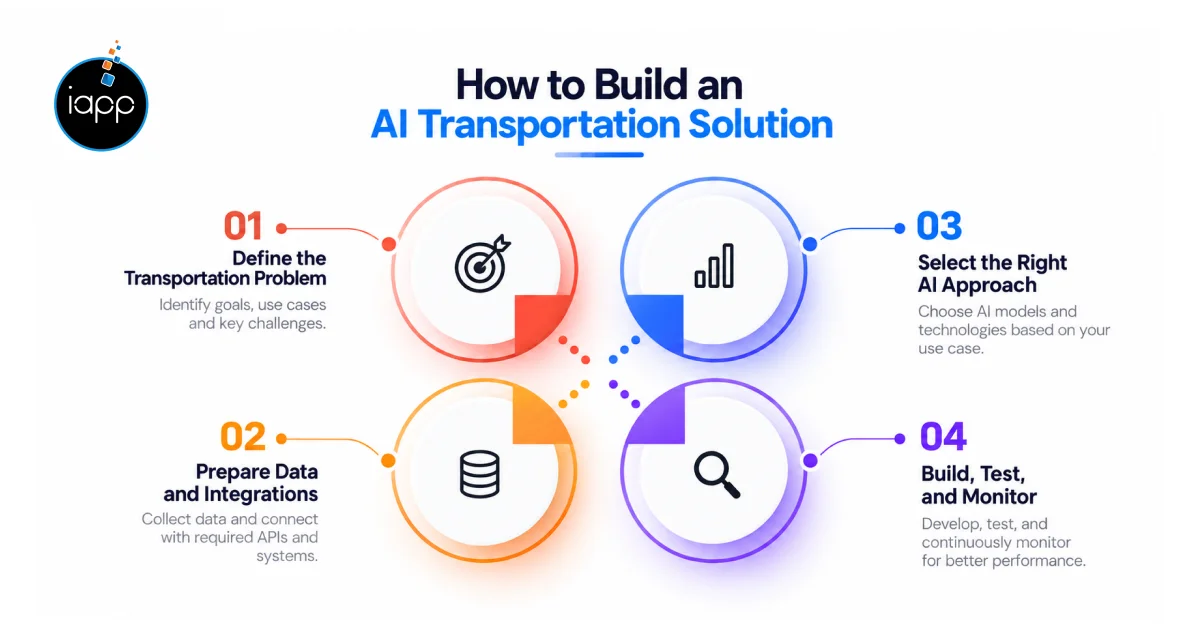
Start with one measurable workflow.
For example:
A focused MVP can usually be planned around one or two core workflows.
Define the data necessary for the chosen process. This may contain GPS logs, vehicle data, journey history, traffic information, customer records, and upkeep history. The quality of the data matters, as poor inputs might lead to incorrect suggestions.
Different problems require different technologies.
A production solution requires more than a trained model. Typical architecture entails a mobile app, an online dashboard, a backend API, database, AI service, and a monitoring layer.
For MVP transportation apps, the business should expect 10-16 weeks’ time. On the other hand, a larger platform might take 5 to 9 months. However, actual time depends on integrations, data readiness, platforms, and testing needs.
Reliable AI transportation technology is based on clean data, robust integrations, regulated outputs, and constant monitoring.
Transportation apps can handle daily GPS and telematics updates. On larger systems, you may use technologies like Kafka to manage streams of events. Also, PostgreSQL can handle structured application data.
Transportation software may include driver, customer, vehicle as well as business info. Use encrypted connections, role-based access, secure APIs, and audit logs. Moreover, access should also be different for drivers, dispatchers, supervisors, and admins.
It is not necessary for AI to automatically trigger actions in every case. For high-impact judgments, the application might provide a suggestion initially. Then a dispatcher may accept or reject the suggestion.
We aid businesses to link AI with transportation products, backend systems, and customer-facing apps. Our focus is on turning defined workflows into practical software features.
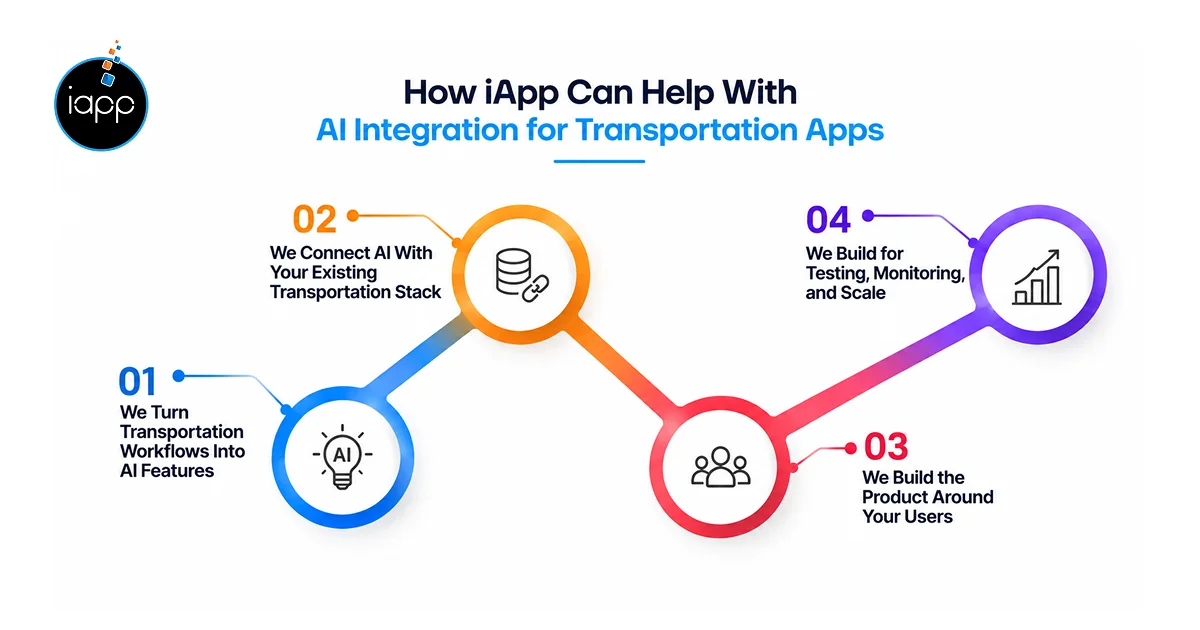
Our devs begin by mapping the existing workflow. Then, we identify where software can decrease manual work or support decisions.
Our planning can cover:
This helps prevent unnecessary AI development.
Our embedded AI capabilities seamlessly integrate into your current applications and business platforms. That can include mobile apps, web dashboards, APIs, databases, maps, GPS systems, and third-party platforms. For example, a current fleet platform may get AI-generated maintenance notifications via its backend API.
There are several user groups of transportation software. We can create processes for drivers, dispatchers, fleet managers, customers, and admins. The result can include separate mobile and web interfaces based on each user’s responsibilities.
We want to test on actual transit situations. This includes API failures, no GPS data, wrong estimates, traffic changes, and excessive amounts of requests. For larger platforms we can additionally arrange cloud infrastructure, monitoring, logging, and controlled model changes.
Our work can cover AI solutions for transportation businesses, from focused MVPs to larger transportation platforms.
AI in transportation is moving beyond research into practical planning, fleet, logistics, traffic, and customer applications. The strongest projects connect AI with reliable data, mobile apps, web platforms, APIs, and clear business workflows.
At iApp Technologies, we build AI-powered mobile and web applications around specific business requirements. Our teams can support AI transportation software development, integrations, backend systems, dashboards, and customer-facing applications. We are the leading AI transportation software development company in the US and worldwide.
If you are wondering how to develop AI solutions for transportation, our expert developers can assist. Share your transportation app requirements with us.
A focused AI transportation MVP can start around $40,000 to $80,000. Larger platforms can exceed $150,000 based on AI complexity, integrations, security, and scale.
A focused MVP can take around 10 to 16 weeks. A larger platform may require 5 to 9 months for integrations, testing, and production deployment.
Transportation systems commonly use machine learning, optimization algorithms, computer vision, predictive analytics, and natural language processing.
Yes, AI can be added through backend APIs and dedicated AI services. Existing mobile apps, databases, and third-party integrations can remain part of the architecture.
Common inputs include GPS records, trip history, vehicle diagnostics, traffic data, maintenance records, customer data, and operational events.
ROI depends on the use case and baseline performance. Measure fuel, mileage, utilization, maintenance, delivery time, labor, and support costs.
Look for AI, mobile, web, backend, API, security, and integration capabilities. Transportation workflow knowledge is also important for practical implementation.
Yes, GPS and telematics systems can connect through APIs, webhooks, or data streams. The AI layer can then process that information for predictions or recommendations.
Yes, AI can consider delivery windows, traffic, vehicle capacity, driver availability, and route conditions. It can then support routing and dispatch decisions.
AI can identify inefficient routes, excessive idle time, poor vehicle utilization, and driving patterns. These insights can support targeted operational changes.
 Jagwinder Singh
Wait! Before you go…
Talk to our experts and turn your ideas into powerful digital solutions.


 Trusted by 1000+ businesses

Fill out the form and our team will get back to you shortly.