Many businesses start experimenting with advanced language models expecting fast wins —only to run into the same problems: inaccurate responses, hallucinations, weak domain understanding, and concerns around data security.
That’s where generic models often fall short.
As enterprise use cases grow more complex, .businesses are turning to tailored language model solutions to build solutions designed around their own data, workflows, and business goals instead of relying on one-size-fits-all models.
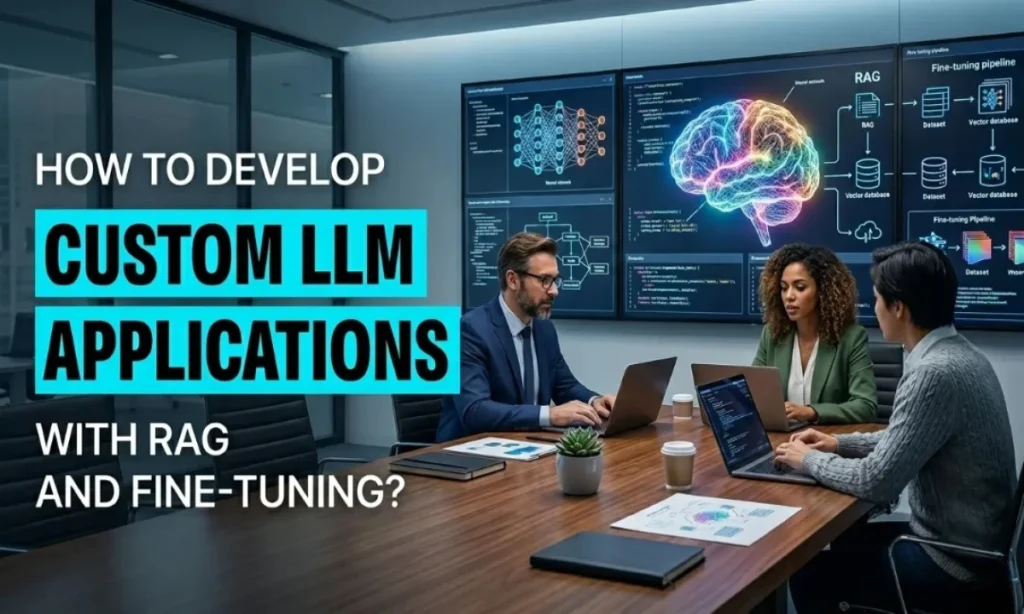
Two approaches are driving many of these solutions: RAG (Retrieval-Augmented Generation) and LLM Fine-Tuning. RAG improves how models access information, while fine-tuning improves how models perform for specialized tasks.
Whether the goal is smarter internal tools, advanced AI Chatbot Development, scalable enterprise applications, or solutions built by a mobile app development company integrating AI into digital products, understanding RAG vs Fine-Tuning for Enterprises has become critical for building reliable solutions.
In this blog, we’ll break down how custom AI applications are developed , where each approach fits, and how businesses can choose the right path for long-term success.
Custom language model development revolves around creating customized language models that take into account the unique requirements of businesses instead of cramming ready-made models into existing workflows.
Custom language model development entails developing bespoke AI language models that cater to the unique needs of the businesses instead of fitting readily available tools into intricate workflows.businesses are turning to Custom LLM Development
As each business operates in a distinctive manner, there may be limitations in utilizing readymade models for such purposes. Businesses often require deeper domain understanding, secure access to internal knowledge, smooth integration with existing systems, and outputs they can trust.
That’s where custom development adds real value—by shaping language model solutions around the way a business actually operates, instead of asking the business to adapt to the technology. That’s where custom development makes a difference.
Instead of using one model for everything, businesses can build specialized AI applications tailored for very specific purposes, such as:
The value here isn’t just in using an LLM—it’s in shaping it around business outcomes.
Better Context for Specialized Work
Generic models often lack the context needed for domain-heavy tasks. Custom applications close that gap by aligning model behavior with business knowledge.
More Meaningful Automation
Many Large Language Model Applications reduce repetitive work, accelerate internal processes, and improve decision-making.
Stronger Enterprise Readiness
For organizations building Enterprise LLM Solutions, customization strengthens governance, security, and scalability beyond public models.
Long-Term Business Value
An increasing number of organizations shift from experimentation toward measurable results—and in many cases, they start realizing that value through custom applications
Thus, inquiries like How to Build a Custom LLM grow more and more common when organizations start implementing their AI models.
After developing an AI model, organizations face the task of making it work effectively in practical situations, which means that two primary techniques are usually used: RAG and LLM Fine-Tuning.
Developing a custom LLM application is not an issue; what is much harder is ensuring that it works effectively for users.
Even sophisticated models might fail in handling outdated data, lack of context, or irrelevant responses with a high degree of confidence. That is why techniques such as RAG (Retrieval-Augmented Generation) and LLM Fine-Tuning became essential for modern AI development.
Despite the fact that both methods help improve model performance, they address entirely different issues, and knowing the difference is crucial for creating effective custom applications.
RAG gives a model access to external knowledge sources before it generates a response. Instead of relying only on what the model learned during training, it can retrieve relevant information from documents, databases, or internal systems in real time.
That creates a major difference for applications that depend on accurate, current information.
Businesses use RAG to:
This is one reason RAG is often used in knowledge assistants and AI Chatbot Development projects.
Fine-tuning takes a different route. Instead of adding external retrieval, it improves the model itself.
By training a model on domain-specific examples, businesses can improve how it understands specialized tasks and responds in ways that fit their needs.
Model fine-tuning improves:
For specialized use cases, this significantly improves model behavior.
In many enterprise AI applications, businesses use both RAG and LLM Fine-Tuning together because each improves a different part of the solution.
Fine-tuning helps models handle specialized tasks with more consistency, while RAG strengthens responses by pulling in relevant and current information when it’s needed
When combined, they create stronger outcomes by helping organizations:
For many enterprises, te best results come from using both approaches as part of a strong retrieval framework and model strategy.
When comparing RAG vs Fine-Tuning for Enterprises, the real question is not which approach is better, but which one aligns best with your business goals. Some use cases need stronger knowledge retrieval, while others require deeper model specialization. In many cases, the right answer may involve both.
If your application relies on accurate, up-to-date information, RAG (Retrieval-Augmented Generation) can be a strong approach. Instead of depending only on what a model learned during training, it retrieves relevant information before generating a response, which makes outputs more grounded and context-aware.
This is one reason RAG is widely used for enterprise search, knowledge assistants, and information-heavy support systems. A well-planned retrieval framework improves response quality, reduces hallucinations, and supports scalable applications built around trusted data.
If the bigger challenge is making a model perform better for domain-specific tasks, LLM Fine-Tuning often becomes the stronger fit.
Rather than improving information access, it improves model behavior. It helps the model understand industry context more effectively, handle specialized tasks, and generate outputs that feel aligned with business requirements.
For organizations building advanced solutions, this is often where a general model starts becoming a more tailored solution.
For many enterprises, it is not really a choice between one or the other.
RAG can strengthen the knowledge layer, while fine-tuning strengthens how the model uses that knowledge.
Together, they often support stronger specialized AI applications that balance accuracy, specialization, and scalability far better than relying on a single approach alone.
Building strong enterprise AI solutions is about much more than choosing the right model. In practice, success often depends on how the entire system is designed—from retrieval and customization to security and scalability. A thoughtful architecture can be the difference between an interesting prototype and a solution that delivers real business value.
A reliable retrieval architecture often starts with how enterprise knowledge is organized and retrieved. When the retrieval layer is designed well, models can generate responses that feel more relevant, grounded, and useful.
Strong implementations often focus on areas such as:
When these pieces work together, retrieval-powered applications tend to perform much more effectively in real-world use.
In many LLM applications, response quality often comes down to retrieval quality.
Even strong models can struggle if the wrong information is surfaced or useful context is missed. That’s why improving retrieval often has a bigger impact than many teams expect.
Refining relevance, context selection, and retrieval logic drives major performance gains over time.
While retrieval improves knowledge access, Model customization can help improve how models perform for specialized business tasks.
It makes outputs more consistent, improves domain understanding, and aligns models naturally with business workflows.
For many enterprise use cases, this is where solutions start feeling less generic and much more purpose-built.
Modern applications, including enterprise web development solutions, often need more than retrieval and generation alone.. They may also depend on orchestration layers, tool integrations, and secure deployment environments to support more advanced workflows.
This supports things like:
These layers often play a major role in making solutions practical for enterprise adoption.
Scalability usually works best when it is planned from the start, not added later.
Infrastructure choices, retrieval performance, and optimization strategies often influence how well an application can grow as usage increases.
For many businesses, designing with scale in mind early helps create Enterprise LLM Solutions that can support long-term growth rather than requiring major rework later.
Building private language model solutions creates major opportunities, but it also introduces challenges businesses often underestimate at the beginning.
One of the biggest concerns with LLM applications is trust.
If responses are inconsistent or inaccurate, even advanced systems can struggle to deliver value. That is why grounding strategies, retrieval optimization, and response validation often become critical parts of improving performance.
For many businesses, solving this challenge is where real adoption begins.
Sometimes the model is not the problem at all.
The issue is retrieval.
Poor relevance, weak embeddings, or low-quality context reduce response quality significantly. In many cases, Improving retrieval performance often delivers more impact than switching models.
This is one reason architecture decisions matter so much.
Enterprise deployments often bring concerns around privacy, compliance, and governance that go beyond model performance.
These requirements can shape architecture decisions just as much as technical considerations, particularly in enterprise environments handling sensitive data.
This is often where secure implementation planning becomes essential.
Many LLM projects perform well during pilots but become far more complex in production.
As scale increases, latency, orchestration, and infrastructure demands often become major factors.
Planning for scale early drives long-term success.
Another challenge many organizations face is integration.
Even strong models can create limited business value if they do not fit naturally into enterprise workflows, tools, and data systems.
Often, integration is what turns an isolated tool into a practical business solution.
Sometimes the hardest challenge is not technical at all.
It is deciding where to start, what approach to prioritize, and how different technologies should work together.
And often, the long-term success of custom AI model development depends as much on that strategy as it does on the model itself.
Businesses today are using Custom LLM Applications for much more than experimentation. They’re applying them to solve everyday business challenges, improve efficiency, and create practical value across teams and departments.
Here are some of the ways organizations are putting these solutions to work.
Many businesses are using LLM-powered assistants to make internal knowledge easier to access. Instead of employees spending time searching through manuals, documentation, or scattered systems, they can get relevant answers much faster.
Business Impact
✔ Faster access to information
✔ Less time spent on manual searches
✔ Better support for internal teams
Real-World Example
An internal knowledge assistant connected to company resources can help teams quickly find policies, process information, or operational guidance—saving time and improving productivity.
One of the most common use cases for AI Chatbot Development is improving support and customer interactions.
Custom chat solutions can handle routine questions, speed up response times, and create smoother support experiences while reducing pressure on service teams.
Where Businesses Apply It
✔ Support automation
✔ Virtual customer assistants
✔ Conversational support experiences
Real-World Example
A software company might use a chatbot connected to its help documentation to answer customer questions instantly and reduce support tickets.
Many AI-powered applications are being used to support everyday workflows and repetitive tasks.
From internal copilots to productivity assistants, these tools improve efficiency by supporting task execution and reducing manual effort.
Common Business Uses
✔ Workflow support
✔ Task automation
✔ Productivity-focused assistants
Real-World Example
Teams in finance, HR, or operations may use copilots to help with reporting, document handling, or routine internal tasks.
With a well-designed RAG Architecture, businesses can improve how employees search, discover, and use information across large content repositories.
This can make enterprise search more useful and reduce time spent looking for the right information.
Example Use Cases
Real-World Example
Legal or compliance teams can use retrieval-powered systems to surface relevant documents and information much faster than traditional search methods.
Some businesses need solutions built around industry-specific challenges where generic models may not perform well enough.
That is where tailored enterprise AI solutions are often delivering value—especially in industries with specialized workflows or strict compliance requirements.
Where Custom Development Adds Value
✔ Domain-specific automation
✔ Specialized knowledge tools
✔ Industry-focused assistants
✔ Secure enterprise applications
Real-World Example
In healthcare, private LLM solutions can support secure knowledge access for internal teams while helping maintain data privacy requirements.
These examples show that Custom LLM Applications are no longer just experimental projects. They are increasingly being used to solve real business problems—from improving internal efficiency to creating better customer experiences.
And for many organizations, that is where the real value of custom LLM development begins.
Choosing an LLM development partner is often about finding a partner that can support both technology execution and business goals.
Technical Expertise Beyond Models
Strong development support often goes beyond model implementation.
Look for teams that can help with architecture design, retrieval systems, fine-tuning strategies, and scalable deployment planning—not just model integration.
Experience With Enterprise Use Cases
Enterprise projects often require much more than experimentation.
A strong partner should be able to support Enterprise AI Solutions designed for real-world performance, scalability, and integration.
Strategic Support for RAG and Fine-Tuning
The right team should help evaluate RAG vs Fine-Tuning based on your use case and business priorities.
That kind of guidance often shapes better long-term outcomes.
Scalability, Security, and Ongoing Support
Strong AI development services often include more than delivery.
Support may include:
These factors often matter just as much as initial implementation.
A Business-Focused Development Approach
The right partner should not just build technology, but help align solutions with business outcomes.
That is often where custom development creates more value.
Building enterprise-grade AI solutions often takes more than selecting the right tools or models. It usually requires the right mix of technical expertise, practical execution, and long-term thinking. That’s often why businesses look for partners who can support not just development, but the broader strategy behind it.
One reason businesses seek the right development partner is the need for solutions tailored to their specific goals, workflows, and challenges.
At iApp Technologies LLP, the focus is often on helping businesses shape solutions around real use cases—whether that involves retrieval-powered applications, customized models, or enterprise-scale deployments.
The emphasis is often less about applying a fixed approach and more about building what makes sense for the business.
Many enterprise projects need a combination of technologies rather than a single implementation path.
Support may often involve:
Having experience across these areas can help businesses evaluate what approach fits best based on their needs.
For many organizations, the goal is not just to test ideas but to build solutions that can work reliably in production.
That is often where scalable Enterprise LLM Solutions matter—solutions designed with performance, growth, and long-term usability in mind.
Supporting that move from concept to real implementation is often where experienced development support makes a difference.
Many successful projects need more than development alone.
They often benefit from support across strategy, architecture, deployment, and optimization—which is where End-to-end language model development services deliver value.
This kind of broader support can help simplify implementation while improving long-term outcomes.
For businesses exploring How to Build a Custom LLM, choosing the right partner is often about more than launching a project.
It is often about having support for future growth, evolving use cases, and continued innovation as needs expand.
And for many businesses, that long-term perspective is what matters most.
Building successful custom AI applications is not about choosing trends—it is about choosing the right strategy.
Whether the need is retrieval-powered systems, specialized models, or scalable enterprise AI solutions, the strongest outcomes come from aligning architecture, data, and development with business goals.
As organizations evaluate RAG vs Fine-Tuning for Enterprises, many are moving beyond experimentation and investing in production-ready solutions.
Ready to move from experimentation to enterprise-grade AI? Partner with iApp Technologies LLP to build secure, scalable custom LLM solutions powered by RAG and fine-tuning—and turn your AI use case into measurable business results. Contact our experts today to get started.
Choosing a Custom LLM Development Company often starts with looking beyond technical expertise alone.
A strong partner should understand your use case, business objectives, and long-term scalability needs. It also helps to work with a team that can support architecture decisions and practical implementation—not just development.
The right partner is often one that understands both technology and business outcomes.
That depends on what you are trying to solve.
If your priority is improving access to knowledge and response accuracy, RAG (Retrieval-Augmented Generation) may be a strong fit. If the goal is to make a model perform better for specialized tasks, LLM Fine-Tuning may make more sense.
In many real-world enterprise use cases, businesses often use both together.
The cost of Custom LLM Development can vary based on the complexity of the solution, architecture needs, integrations, and deployment requirements.
A lightweight proof of concept will naturally differ from a large-scale enterprise implementation. In most cases, the investment depends on the use case and the scope of the solution being built.
Before deciding How to Hire LLM Developers, it helps to look for more than model experience.
Practical expertise in retrieval systems, fine-tuning, secure deployments, and scalable implementation can be just as important. It often helps to choose developers who understand solving business challenges—not just building technical features.
For many organizations, Enterprise LLM Solutions can be a worthwhile investment when tied to clear business goals.
They can support automation, improve productivity, and help teams work with information more effectively. The value usually comes not from adopting the technology itself, but from applying it to the right use cases.
That is often what drives meaningful returns.
Many businesses choose LLM Development Services providers to access specialized expertise, move faster, and reduce implementation risk.
For some teams, partnering externally also makes it easier to validate strategy, accelerate development, and build more scalable solutions than starting entirely from scratch.
 Jagwinder Singh
Wait! Before you go…
Talk to our experts and turn your ideas into powerful digital solutions.


 Trusted by 1000+ businesses

Fill out the form and our team will get back to you shortly.