

Digital tax filing is already the dominant way Americans submit individual tax returns. In FY 2025, 93.7% of individual tax returns were filed electronically with the IRS.
Building an app like TurboTax therefore requires more than a basic tax calculator. It needs secure filing workflows, tax rules, document processing, e-filing integrations, reliable calculations, and controlled AI assistance.
This guide explains how to build an app like TurboTax, including features, technology, cost, security, and development requirements.
A TurboTax-like app is a digital tax platform, not simply a tax calculator. It helps users collect tax information, calculate obligations, prepare returns, and complete filing tasks.
The platform can serve individuals, freelancers, self-employed users, accountants, and small businesses. It can also connect users with tax professionals when complex cases need human support.
A typical tax preparation app development project can include:
A tax calculator mainly estimates tax amounts. On the other hand, a complete filing platform manages information from data collection through submission. That difference significantly affects TurboTax app development scope and cost.
The right feature set should support the user’s complete filing process. If you are looking for how to build an app like TurboTax, start with essential filing features before adding advanced capabilities.
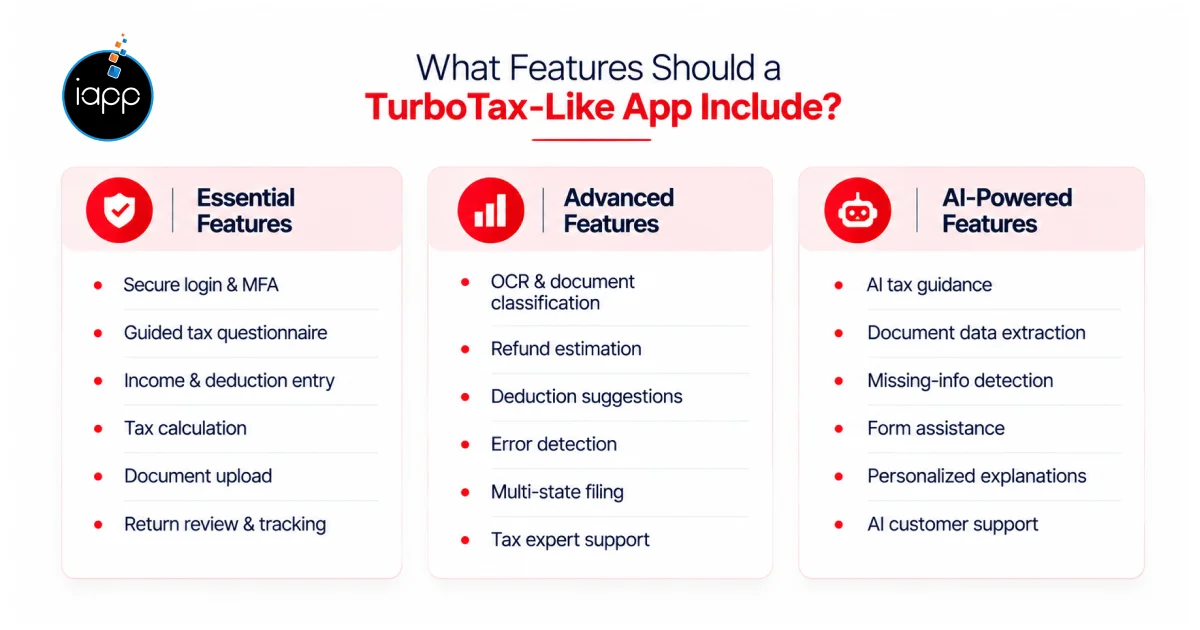
A practical MVP can include:
Once the core workflow works, add features such as:
These features increase the scope of tax filing app development. But they can also reduce manual data entry for users.
AI tax app development can support users without replacing the underlying tax rules.
Useful applications include:
For example, an individual could upload a 1099 tax form and expense documents. The app can extract relevant information and ask only applicable questions. The tax engine can then calculate results using validated tax rules. This separation helps keep calculations controlled and easier to audit.
Note: Build around user filing scenarios instead of copying another product screen by screen. For tax app development, start with the users, forms, jurisdictions, and filing cases you actually support.
A tax filing app should move users through a clear sequence. This workflow connects the user interface with tax rules, documents, integrations, and security controls.
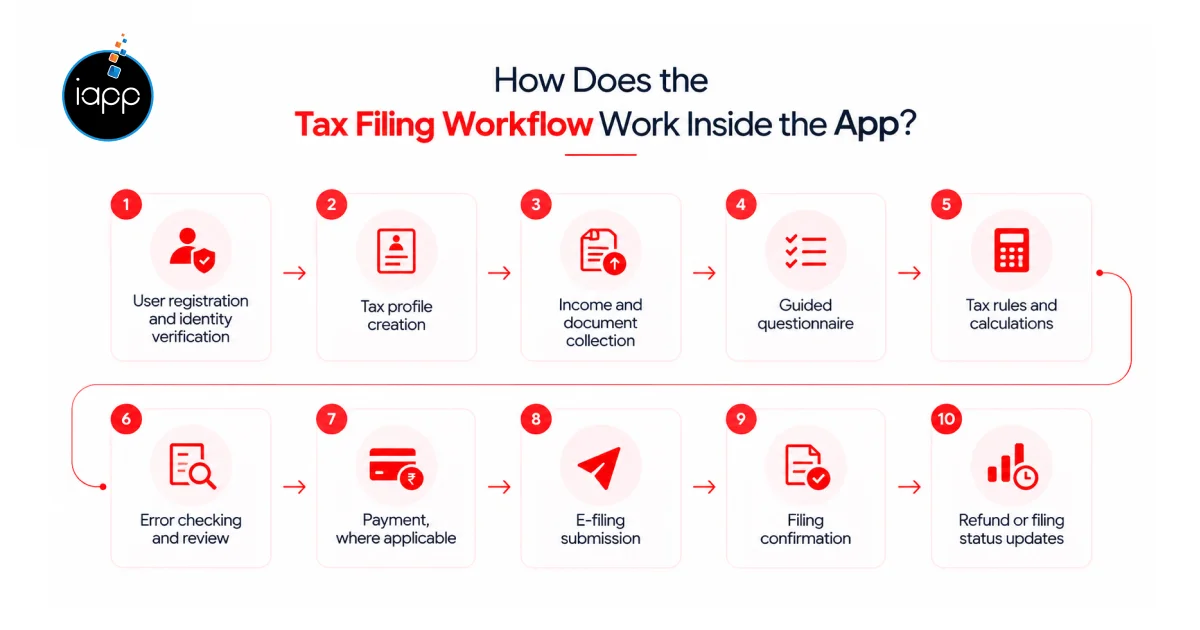
The system should use conditional questions based on user responses. It should also maintain separate rules for different tax years. Federal and state requirements may require separate calculation logic. A secure audit trail should record important changes and filing actions.
The user provides information once. The system organizes it, applies relevant rules, prepares forms, and supports filing.
This approach makes tax filing software development more structured. It also gives product teams clear points for testing and monitoring.
There is no single technology stack for every tax software development project. The right choice depends on users, platforms, integrations, security, and expected traffic.
| Layer | Recommended Technology | Purpose & Architecture |
|---|---|---|
| Tax Rules Engine | Drools, Corticon, or Custom DSL (C# / Go) | Deterministic Business Rule Engines (BRE) to isolate tax code logic from general API code, supporting precise multi-year tax calculations. |
| IRS & State Integration | XML Schemas, SOAP/REST APIs, IRS MeF Pipeline | IRS Modernized e-File (MeF) protocol compliance, handling transmittal packages, digital signatures, and e-file acknowledgment parsing. |
| Workflow & State Machine | Temporal, AWS Step Functions | State-machine orchestration for multi-step filing workflows, session persistence, and immutable audit logging. |
| Document OCR & Processing | Amazon Textract, Google Cloud Document AI | Specialized financial OCR tuned for IRS tax forms (W-2, 1099, 1098) with automated validation against user entries. |
| Backend APIs | Node.js, Python (FastAPI), or Java (Spring Boot) | Secure microservices for authentication, payment handling, and third-party API orchestration. |
| Database | PostgreSQL + Redis | ACID-compliant relational storage for financial ledger data, paired with in-memory caching for session management. |
| Security & Compliance | KMS (Key Management Service), AWS GovCloud | AES-256 field-level encryption, SOC 2 Type II controls, and IRS Publication 1075 compliance. |
For mobile tax app development, Flutter can reduce duplicated interface development. React Native can provide another cross-platform option. Also, the backend should keep tax rules separate from general application logic. That structure makes future tax-year updates easier to manage.
APIs may connect the platform with payment, identity, document, and filing services. For this reason, each integration should have clear failure handling and monitoring.
The tax app development cost can range from about $60,000 to $800,000 or more.
The final budget depends heavily on product scope, integrations, security, and supported jurisdictions.
| App Complexity | Estimated Cost | Typical Scope |
|---|---|---|
| Basic | $ 60,000– $ 120,000 | Calculator, profiles, basic filing |
| Mid-Level | $ 150,000–$ 300,000 | Guided filing, documents, payments |
| Advanced | $ 400,000–$ 800,000+ | AI, tax engine, e-filing, multi-state |
These figures are planning ranges, not fixed market prices.
A complex fintech app development cost can increase quickly with integrations and compliance requirements.
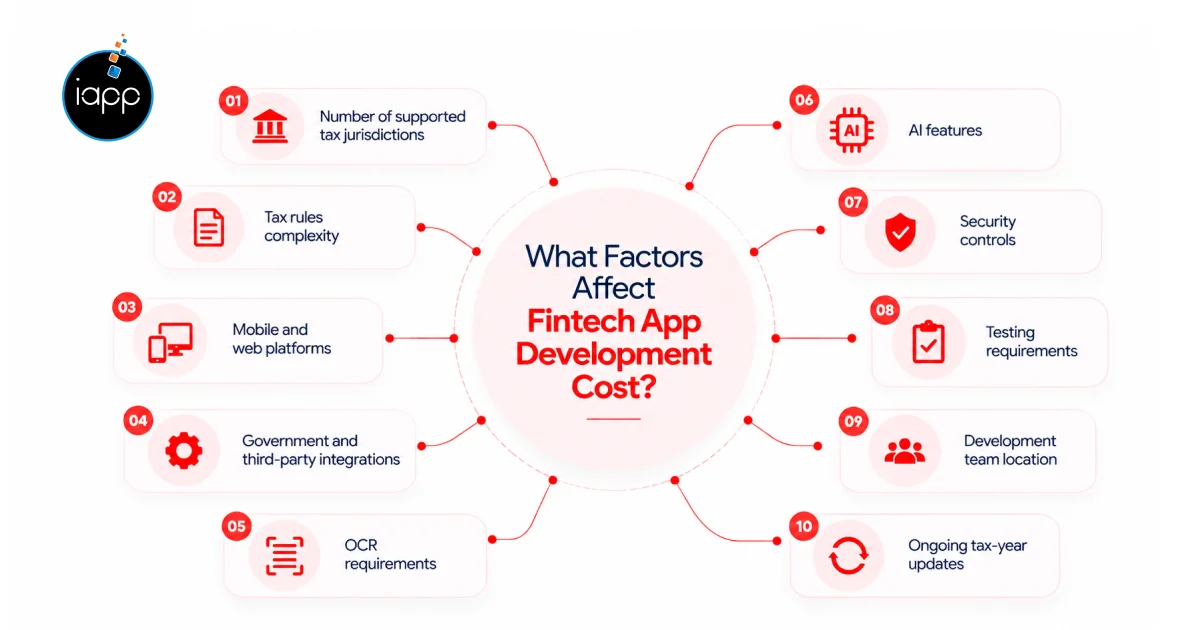
Key cost drivers include:
A basic calculator needs far less work than a complete filing platform. Therefore, defining the MVP first can prevent unnecessary development costs.
Tax applications handle highly sensitive financial and identity information. Security should therefore be part of the architecture from the beginning.
A production platform should consider:
Requirements also vary by product and jurisdiction. A US-specific tax platform may have different requirements than a platform serving multiple countries. Apps transmitting tax returns to the IRS must comply with IRS Publication 1075, maintain SOC 2 Type II certification, and pass IRS Authorized e-File Provider (ETIN/EFIN) qualification checks. Therefore, teams should confirm these requirements before designing the final filing architecture.
Note: Compliance should shape architecture from the planning stage. Treating compliance as a final checklist can create expensive redesign work later.
AI can make tax software easier to use, especially for documents and user guidance. However, AI should support validated tax logic rather than replace it.
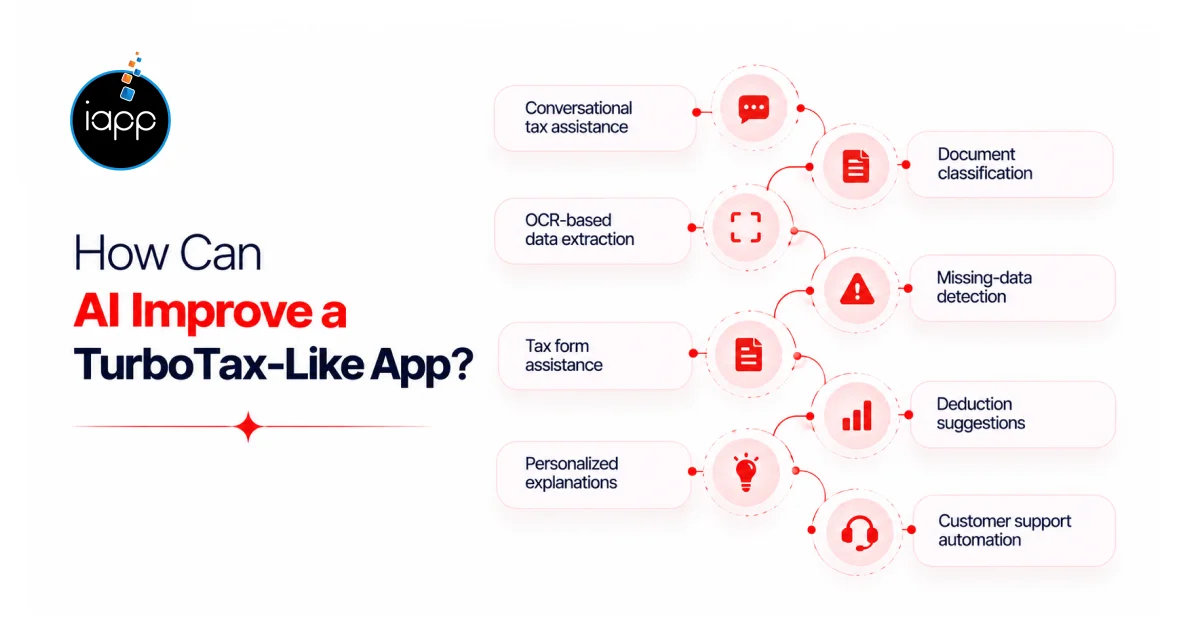
Useful applications include:
Deloitte’s 2025 survey covered 1,000 tax and finance leaders. It found that 57% considered AI skills essential for today’s tax workforce. AI can help users understand complex information in simpler language. It can also reduce repetitive document handling.
Still, sensitive tax decisions need controlled rules and human review. This is especially important when incorrect information could affect a user’s tax return.
We help businesses turn fintech product ideas into defined development plans. Our approach starts with the business model, target users, filing scenarios, and required integrations.
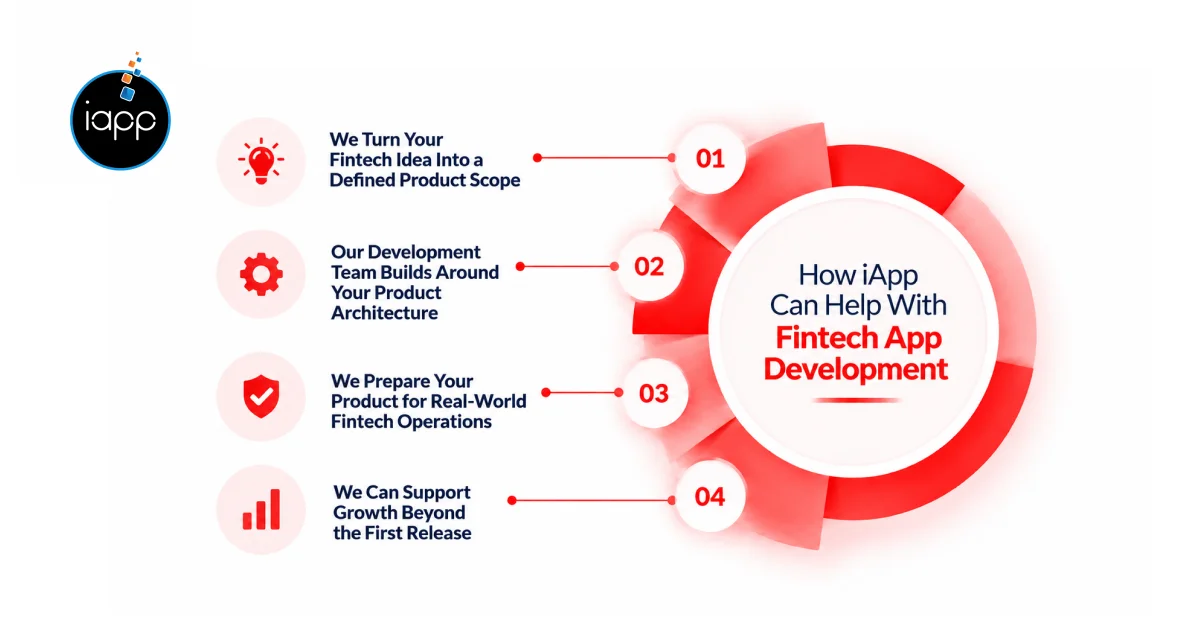
We first map what the product must accomplish.
Our planning can cover:
This gives founders a clearer development scope before coding begins.
We can support the technical implementation across multiple product layers.
Our development work can include:
The architecture can also support future product expansion.
A fintech product needs more than functional screens. That is why our team focuses on scenarios that can affect reliability after launch.
Our work can include:
This approach helps prepare the product for operational demands.
Your first release does not need every possible feature. We can help expand the platform as product requirements become clearer. Our fintech app development services can support both initial builds and later product improvements.
Future work can include:
For companies targeting the American market, our fintech app development USA services can support products built for local regulations and user needs.
Knowing how to build an app like TurboTax starts with defining users, tax scenarios, rules, integrations, and security requirements. The right architecture can then support filing workflows, AI assistance, and future tax-year changes.
At iApp Technologies, we build fintech products around defined business goals and technical requirements. We support product planning, application development, integrations, testing, and post-launch improvements.
A basic product may take several months, while advanced platforms can take much longer. The timeline depends on features, platforms, integrations, tax jurisdictions, and testing.
Yes, cross-platform frameworks can support both platforms from one codebase. Native fintech app development services should be considered when platform-specific requirements justify separate apps.
Yes, but applicable IRS programs and technical requirements must be confirmed first. The integration approach depends on the filing services and product model.
Tax apps can use subscriptions, filing fees, premium plans, or expert assistance. Additional revenue can come from accounting services and related financial products.
Common integrations include identity, payments, OCR, notifications, financial data, and filing services. The exact APIs depend on the product’s target users and filing model.
AI can assist with tax information, but validated tax rules should control core calculations.
Human review can also support sensitive or complex filing situations.
A fintech platform can cost from tens of thousands to several hundred thousand dollars. Scope, security, integrations, platforms, and compliance requirements drive the final budget.
Yes, a product can support freelancers and self-employed users with specialized workflows. These can include 1099 income, business expenses, estimated taxes, and mileage records.
Tax apps use controls such as encryption, MFA, access restrictions, and audit logs. Secure APIs, monitoring, testing, and controlled data retention are also important.
A tax calculator estimates tax amounts from selected inputs. On the other hand, a filing app collects information, prepares forms, validates data, and supports submission.
 Jagwinder Singh
Wait! Before you go…
Talk to our experts and turn your ideas into powerful digital solutions.


 Trusted by 1000+ businesses

Fill out the form and our team will get back to you shortly.