
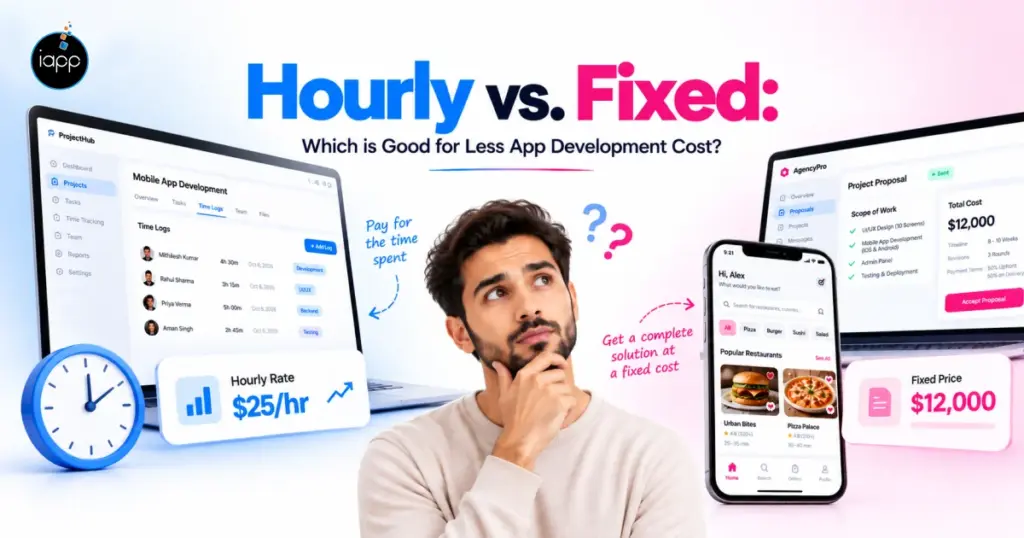
Neither pricing model is always cheaper. Hourly vs. fixed price app development depends on your scope, expected changes, technical complexity, and budget control.
Fixed pricing can provide better cost predictability. It is beneficial if your app requirements are clearly defined. On the other hand, hourly pricing can offer more flexibility. It is best when features, integrations, or technical requirements may change.
This guide compares both models using practical cost examples, project scenarios, and budget factors. You will also see when a hybrid approach may make more sense.
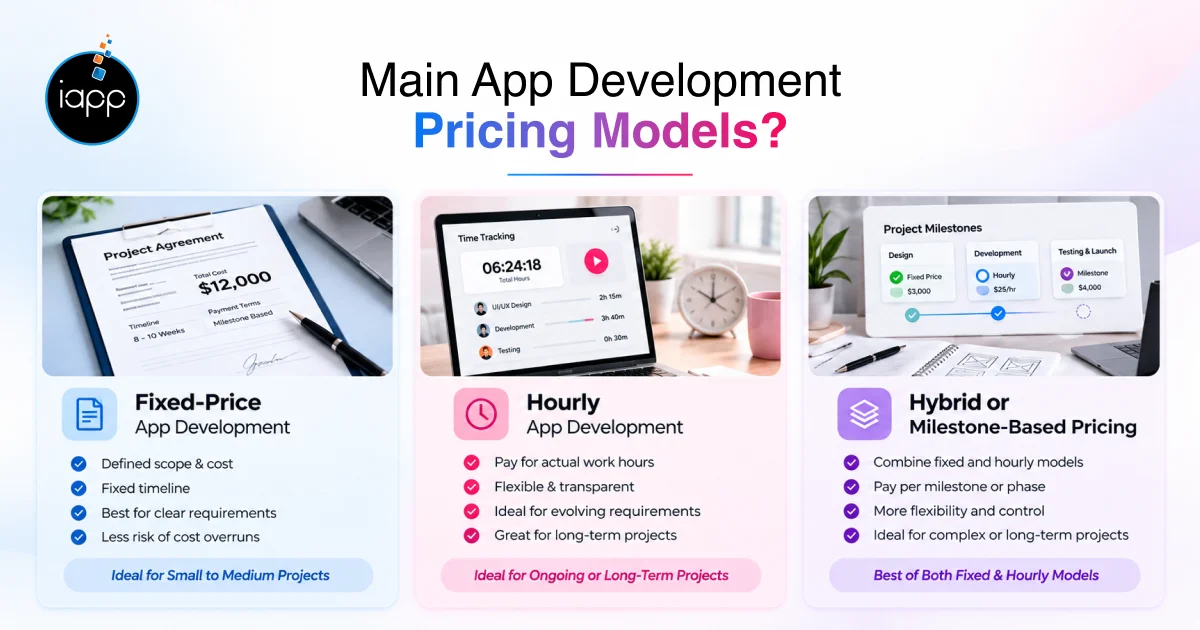
The three common app development pricing models are fixed price, hourly, and hybrid. Each model handles scope, payment, and project changes differently.
With fixed price app development, you agree on scope and price first.
The development team estimates the work before development starts.
The contract usually defines:
This model works well when requirements are already clear.
With hourly app development, you pay for actual development time.
The basic calculation is simple:
Hourly rate × hours worked = development cost
For example, 500 hours at $100 per hour equals $50,000.
The scope can change without rebuilding the entire contract. However, additional features can increase the final invoice.
A hybrid approach combines fixed and hourly billing. For example, discovery can use hourly billing. The approved MVP can then use fixed pricing. This approach can work well when some requirements remain uncertain.
Choosing between hourly and fixed price app development depends on several factors. A lower hourly rate does not always mean a lower final project cost.
A 2024 BCG study of internal software development projects found that nearly half of respondents said more than 30% of their technology development projects experienced delays or budget overruns.
This is one reason pricing should be evaluated alongside project scope, estimated effort, and how likely requirements are to change.
Let us understand it by an example.
For instance, an app requires 500 development hours. At $100 per hour, the approx. estimated development cost would be $50,000. But what if the project grows by 20%? The required effort becomes 600 hours. At the same rate, the new total becomes $60,000. On the other hand, a fixed-price project may remain at $50,000 if the original scope remains unchanged.
The figures below show how different hourly rates can affect a project budget. They are examples for comparison, not industry pricing averages.
| Project scope | Estimated hours | At $75/hour | At $100/hour | At $125/hour |
|---|---|---|---|---|
| Basic MVP | 400 | $30,000 | $40,000 | $50,000 |
| Medium app | 800 | $60,000 | $80,000 | $100,000 |
| Complex app | 1,500 | $112,500 | $150,000 | $187,500 |
These calculations show why the hourly rate should not be your only comparison point. For example, a $75 hourly rate with 1,500 hours costs $112,500. A $125 rate with 900 hours costs $112,500 too.
The second team has a higher rate but requires fewer development hours. When comparing app development pricing of USA providers, review the estimated effort alongside the hourly rate. Also check the included features, technology, integrations, testing, and post-launch support.
Two apps can have similar feature lists but very different development costs. For example, “user login” may include email login, Google Sign-In, Apple Sign-In, OTP verification, password recovery, and account deletion.
The same applies to integrations. A payment feature may require Stripe integration, webhooks, refunds, failed-payment handling, and transaction records.
Other factors can also change development hours:
This is why we recommend comparing each and every element of app development, not just the quoted hourly rate. A $60,000 quote may look cheaper than $75,000, but the lower mobile development cost quote may exclude important product components.
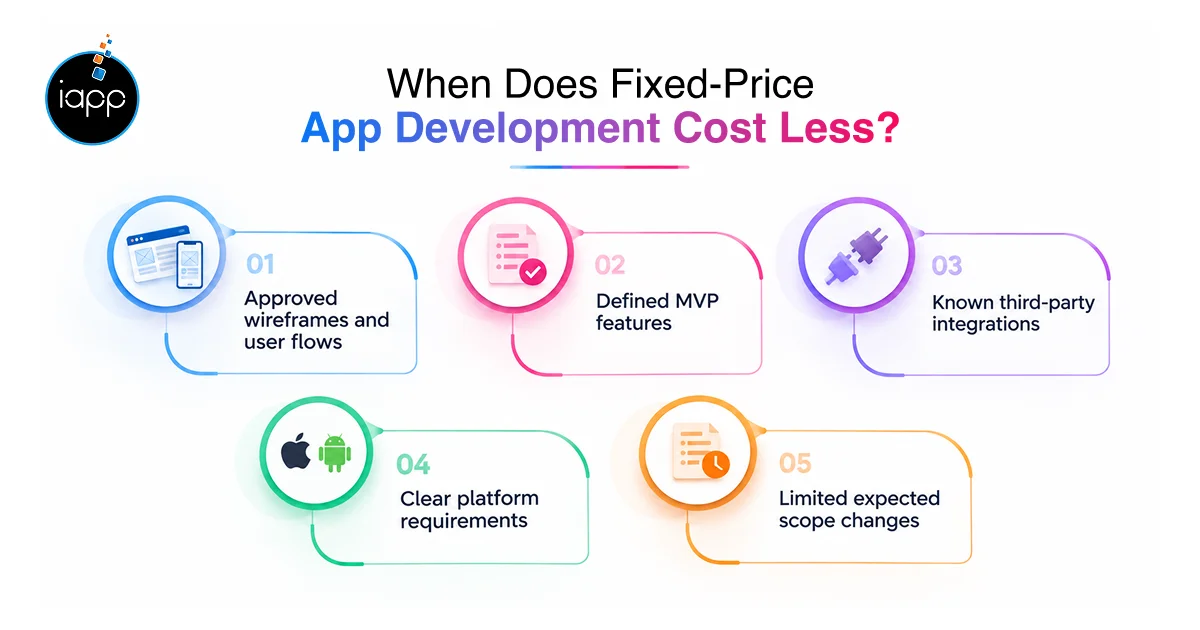
Fixed-price app development can cost less when requirements are stable.
This model fits projects with:
Consider a food delivery MVP. The scope might include customer login, restaurant listings, cart, payments, orders, and notifications. If those features are already approved, a fixed quote can provide useful budget certainty.
The contract should still define what each feature includes. For example, payment integration should specify the payment provider. It should also define supported platforms and testing requirements.
The U.K. government’s agile contracting guidance makes a similar distinction. It states that rigid fixed pricing can be less suitable when project information remains limited.
A strong scope should identify:
This reduces arguments about what the original price covers.
Hourly app development can cost less when requirements are uncertain. It is useful when the product needs testing before the full scope becomes clear.
Common examples include:
Imagine a startup building an AI customer support app. The founder may initially request chat, document search, and user accounts. Testing may show that document retrieval needs more work.
The team may then change the search process. Hourly billing can handle those changes without creating repeated fixed-price amendments. The important point is budget control. An hourly contract should still have limits. You can use a weekly hour cap or monthly budget.
For example, a team could work within a $12,000 monthly development budget. The project lead can review progress every week. This keeps flexibility without leaving spending completely open.
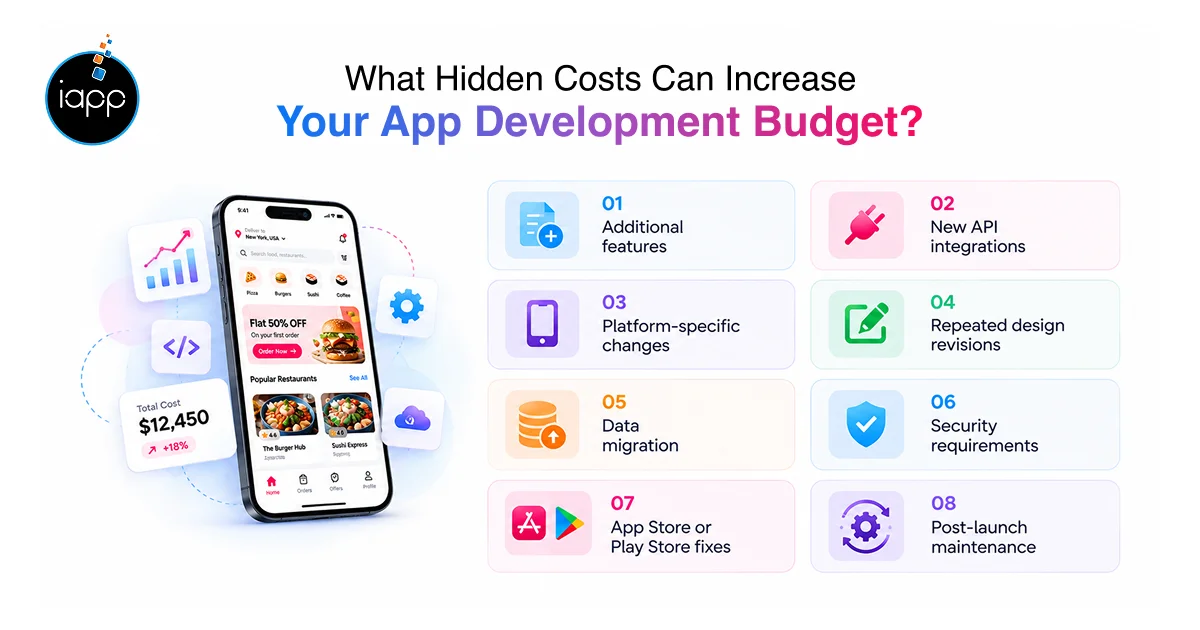
Your app development budget can increase through scope changes, rework, integrations, and unclear requirements.
The original quote is only one part of the total cost.
Watch for these areas:
Let’s consider the example of a simple login feature. Email login may require less work than social login. Adding Google, Apple, Facebook, and enterprise SSO can increase development effort. The same applies to payment systems.
Stripe integration may require different work than a custom payment gateway. This is why how app development pricing works should be clear before signing.
There is no universal answer to hourly vs. fixed-price app development. Your project conditions should determine the model.
| Project situation | Suitable approach | Main cost reason |
|---|---|---|
| Clearly defined MVP | Fixed | Easier budget planning |
| Changing requirements | Hourly | Fewer scope renegotiations |
| Technical discovery | Hourly | Unknown effort can be tested |
| Known features and deadline | Fixed | Scope can be priced upfront |
| Long-term roadmap | Hourly | Priorities can change |
| Defined development phases | Hybrid | Each phase gets its own budget |
Here is another example:
A local service booking app may suit fixed pricing. Its features may include registration, service listings, booking, payments, and notifications. On the other hand, an experimental marketplace may need hourly development. Its business rules may change after early user testing.
So, the key question is not simply:
“Which model is cheaper?”
Ask:
“Which model gives this project the right cost control?”
You can control the mobile app development cost with either pricing model by reducing unnecessary development work before and during the project.
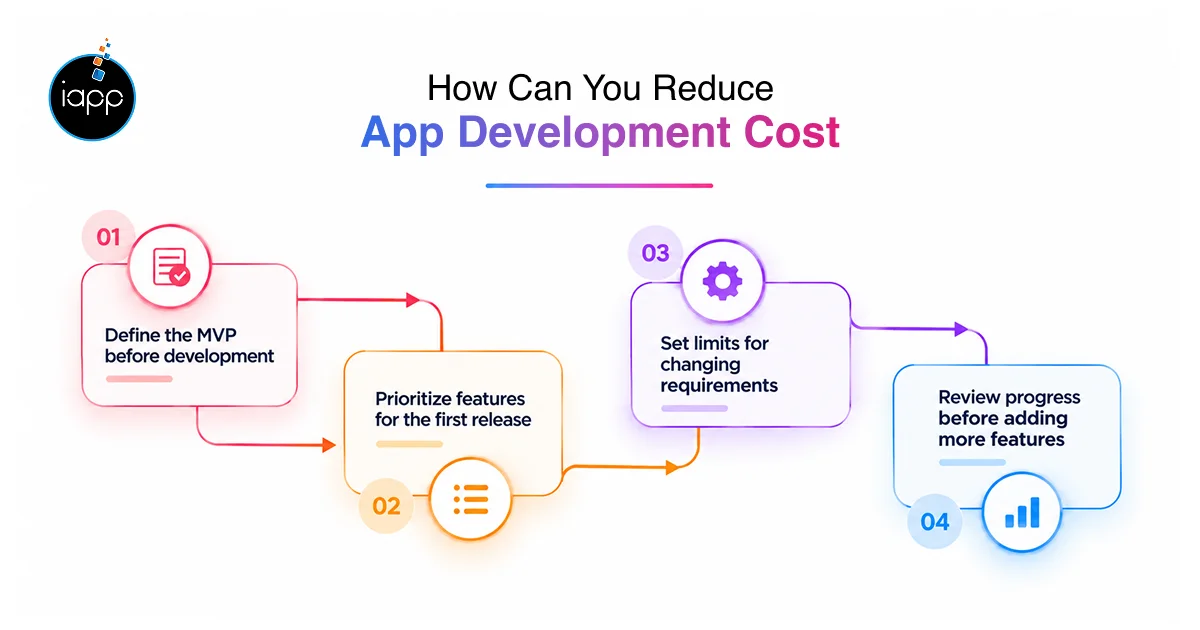
List the features required for the first release before development begins.
Separate them into:
A 2025 study published in Information and Software Technology analyzed 116 software projects and found that insufficient planning and analysis were negatively associated with project outcomes.
For an app project, the study supports a simple approach: define the core product, clarify requirements, and identify technical dependencies before committing significant development hours. This can help reduce rework and make the app development budget easier to manage.
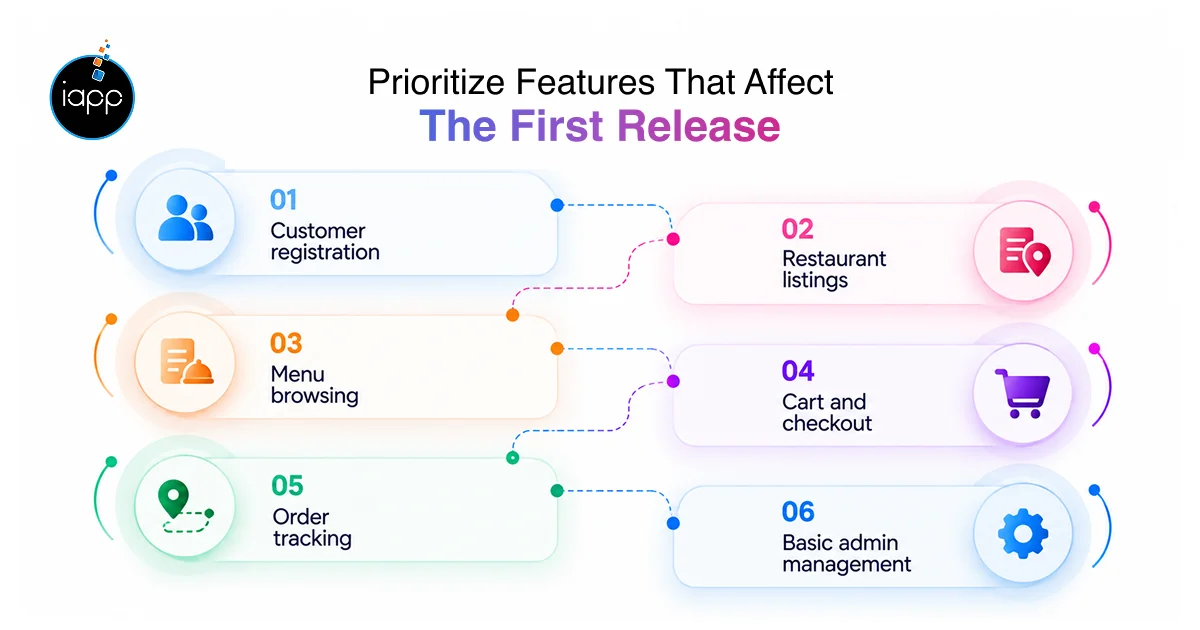
Do not add every requested feature to version one.
For example, a food delivery MVP may need:
Advanced loyalty programs, complex analytics, multiple delivery models, or additional user roles can be planned for later phases.
Changing requirements are easier to manage when there is a clear process for reviewing their effect on cost and timelines. With hourly pricing, track how additional requirements affect development hours. In fixed pricing, identify whether a requested change falls inside or outside the agreed scope.
Regular reviews can help identify unnecessary work before more development hours are spent. For larger projects, divide development into milestones and review the product after each phase. This gives you an opportunity to adjust priorities before committing the remaining app development budget.
At iApp Technologies, we do not use one pricing model for every app project. We first review your features, platforms, integrations, technical requirements, and expected changes. This helps us recommend a pricing structure that fits the project.
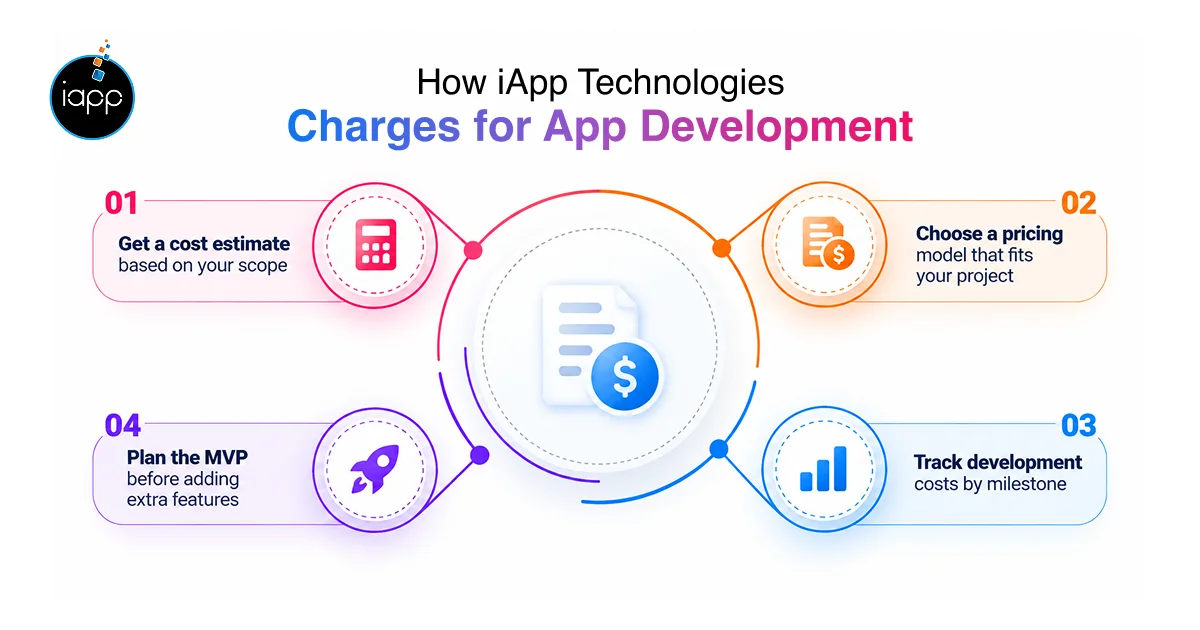
We start by understanding what you want to build.
Our review can cover:
This helps separate essential MVP features from later additions.
We can structure projects around fixed, hourly, or hybrid pricing. A defined MVP with stable requirements may suit fixed pricing. On the other hand, an evolving product may work better with hourly development. Similarly, projects with an uncertain discovery phase can use a hybrid approach.
We can divide larger projects into manageable development phases. Each phase can have defined features, deliverables, and review points. This gives you clearer visibility into progress and spending. It also makes it easier to prioritize the next phase based on actual product needs.
We help identify the features needed for the first release. Features such as advanced analytics, complex integrations, loyalty systems, or additional user roles can be planned for later phases when appropriate.
Starting with a focused MVP can help control the initial app development budget without removing features that are essential to the product.
The right choice between hourly vs fixed price app development depends on your scope and project uncertainty. Fixed pricing can support predictable budgeting, while hourly pricing can support changing requirements.
At iApp Technologies, we review your product scope before recommending an engagement structure. Our team can help define the MVP, estimate development needs, and plan the next phase.
Fixed pricing can suit a small app when its features and requirements are clearly defined. Hourly pricing can work better when the product is still changing.
There is no single app development hourly rate in the USA or any other country. Rates vary based on developer experience, location, technology, project complexity, and team structure.
Usually, fixed pricing covers only the features and revisions included in the agreed scope. New features or major changes may require a change request and additional cost.
Yes, a project can move from hourly to fixed pricing once the requirements become clear. For example, discovery and prototyping can use hourly billing before a defined MVP moves to a fixed-price phase.
Compare the total estimated effort, scope, technology, and included services in lieu of the quoted price alone. Check estimated hours, integrations, testing, support, and exclusions.
A fixed-price contract should clearly define the scope, deliverables, milestones, acceptance criteria, changes, payments, and support. This helps both sides understand what the quoted price covers.
Begin with the MVP scope and focus on the features needed for the first release. Then estimate development complexity and reserve some budget for approved changes or later requirements.
It can remain fixed when the agreed scope does not change. However, additional integrations, or out-of-scope work, can raise the final cost.
Fixed pricing charges for an agreed scope, while time and materials pricing charges are based on actual development effort. Time and materials is similar to hourly pricing because the final cost depends on the hours required.
 Jagwinder Singh
Wait! Before you go…
Talk to our experts and turn your ideas into powerful digital solutions.


 Trusted by 1000+ businesses

Fill out the form and our team will get back to you shortly.