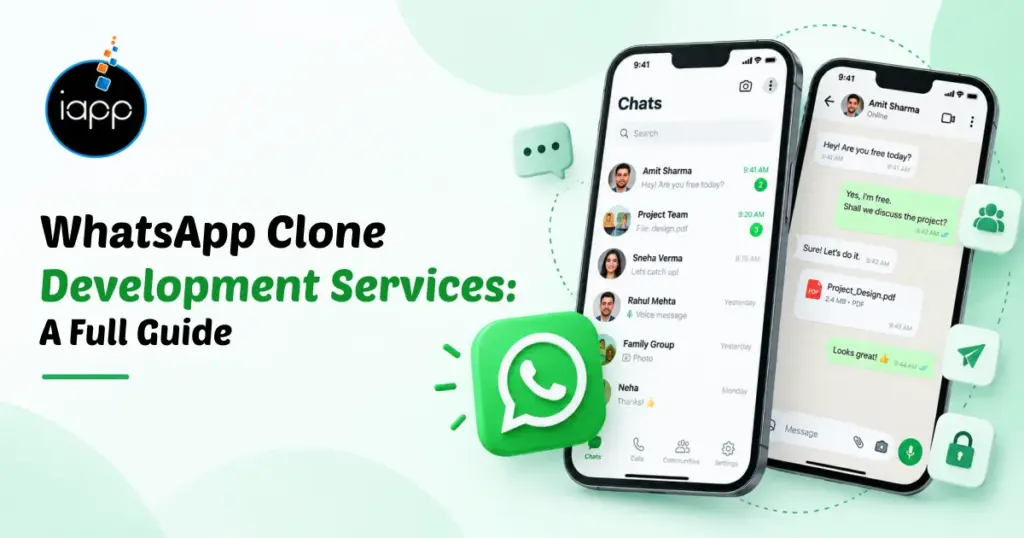
Messaging apps have become a common part of day-to-day communication. People use them to chat, share files, and make calls. According to Pew Research Center, 32% of U.S. adults said they use WhatsApp in 2025.
The platform is also beneficial for businesses that want to remain connected with employees and clients. This has eventually created interest in building apps similar to WhatsApp. A company that develops WhatsApp clone apps can help turn that idea into a branded messaging platform.
A WhatsApp clone does not imply copying WhatsApp’s code or design. This means developing an entirely new app that incorporates communication features similar to those of WhatsApp. This guide will shed light on WhatsApp clone app development. We will discuss the features, development process, cost, technology, and security of the clone app in detail.
A WhatsApp clone app is a messaging platform built around features similar to WhatsApp. It can support private chats, group conversations, media sharing, calls, notifications, and user profiles. The key difference is ownership. A clone app is built as a new product for your business. It can have your brand, interface, features, and business rules. You are not simply copying WhatsApp’s proprietary code or product.
For example, a business could build a messaging platform for:
The app can also connect with CRM systems, payment services, business tools, or custom APIs. That makes WhatsApp like app development useful for businesses in USA and worldwide with a specific communication objective.
According to Salesforce, 65% of customers are engaging with businesses using messaging applications like WhatsApp. Businesses also use chat to answer queries, provide customer service, offer information, and manage communities.
With a customized messaging app, a company has greater control over the branding, functionality, access to users and data, and future upgrades. The increased desire for immediate communication is fueling the interest in message app development.
It can also focus on a specific audience. For example, a healthcare company may need secure patient communication. A learning platform may need student groups and file sharing. At the same time, a service business may need chat, bookings, payments, and support in one place.
The goal should not be copying every feature from WhatsApp. The better approach is to identify the communication problem first. Then build the features around that need.
The right WhatsApp clone app features depend on the target audience. A basic messaging product needs fewer features than a full business communication platform.
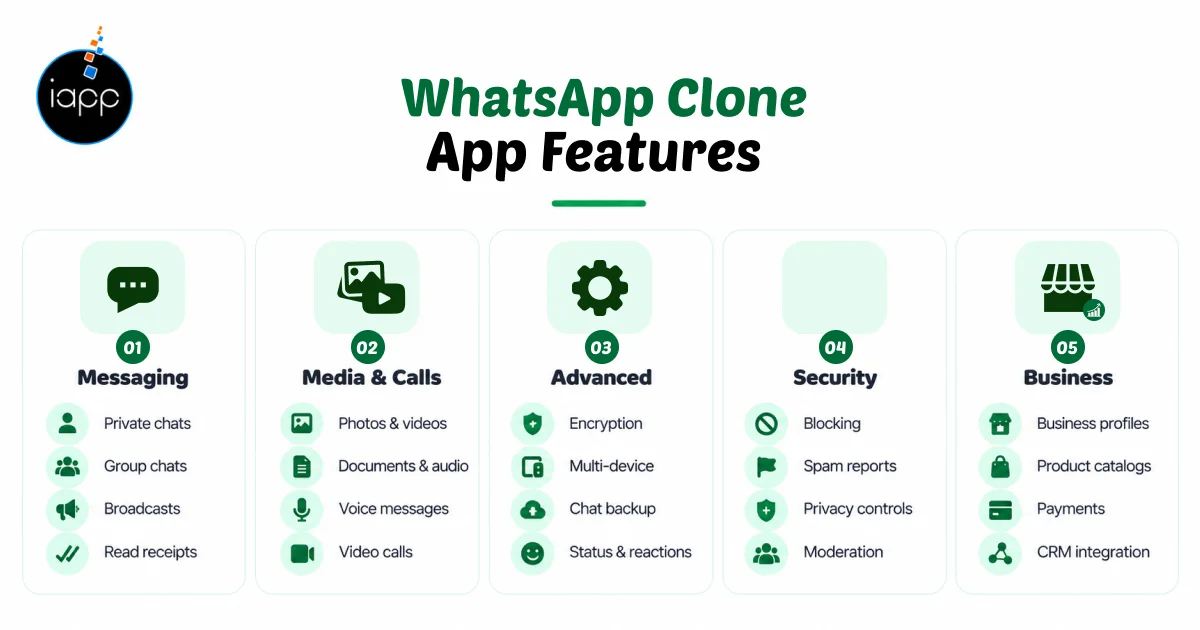
These features form the foundation of most messaging apps:
Messages should appear quickly and reliably. The interface should also make common actions easy to find.
Modern messaging apps need more than text chat.
Users may want to send:
Voice and video calls can also be added. For calling features, developers can use WebRTC or suitable communication APIs. The choice depends on the required call quality, scale, and budget.
A more advanced WhatsApp clone App can include:
Security has to be incorporated into the product strategy from the start. WhatsApp messages and calls are safeguarded with end-to-end encryption in most cases. A new messaging app should also be able to establish its own security strategy, depending on the users and data.
Business-focused messaging apps can go further.
Useful features may include:
These features can make the app useful beyond basic chatting.
If you want to know how to build a WhatsApp clone app, start with the product. Do not begin with technology alone. The features, users, platform, and security needs should guide technical decisions.

First, identify who will use the app. Then define the main communication problem. Decide whether you need an MVP or a larger product.
An MVP may include:
More advanced features can come later. This approach helps control the first development cycle.
The interface should feel simple from the first screen. Plan the main user actions before development begins.
These may include:
The chat screen deserves special attention. Users should be able to send messages, media, and voice notes without confusion.
Building a scalable messaging application requires a decoupled architecture capable of handling millions of concurrent connections with sub-100ms latency. Instead of generic frameworks, your technical architecture should leverage industry-standard communication protocols:
The development team can then build the main systems. This includes the mobile interface, backend, database, APIs, authentication, and notifications. Media storage should also be planned carefully. Moreover, calling features need separate testing for quality and reliability. Security controls should also be added during development.
Testing should include more than basic functions.
The team should test:
After launch, monitoring becomes important. The app may need updates as users increase. New features can then be added based on real usage.
Security cannot be treated as an afterthought or a post-launch add-on. To match enterprise and consumer compliance standards, your app architecture must enforce multi-layered protection:
The WhatsApp clone app development cost in USA or any other country depends on the product scope. Remember, there is no single price for every messaging app. A simple MVP needs less work than a full platform.
| Development Approach | Typical Feature Scope | Technical Complexity | Estimated Cost (US Market Rate) |
|---|---|---|---|
| Minimum Viable Product (MVP) | 1-to-1 text chat, basic user profiles, push notifications, and standard media attachment sharing. | Low to Medium | $30,000 – $50,000 |
| Custom Business App | Group chats, WebRTC-powered voice/video calls, contact sync, admin dashboards, and cloud backups. | Medium to High | $60,000 – $120,000 |
| Advanced Enterprise Platform | Full E2EE (Signal Protocol), multi-device synchronization, automated AI chatbots, CRM integrations, and payment gateways. | High | $150,000+ |
Several factors affect the final budget.
These include:
iOS and Android development can also affect the budget. A cross-platform approach may reduce duplicated development work. However, some products still need platform-specific development. The best estimate comes after defining the required features.

Development time depends on the scope. A basic MVP can move faster than a full messaging platform.
The timeline can change based on:
A simple chat app may have a smaller development cycle. On the other hand, larger platforms need more time for architecture and testing. It is recommended to define the MVP first. Then create a development plan for later features.

Security should be considered before development starts. Messaging apps may handle private conversations, files, contacts, and business data.
Important areas include:
Use secure login methods and protect account credentials. Two-factor authentication can also provide another layer of account protection.
Encryption can protect messages during communication. The required encryption model depends on the product. It should be planned with the application architecture.
Images, videos, documents, and audio files need secure storage. Access rules should prevent unauthorized downloads.
APIs should use proper authentication and access controls. Rate limits can also help reduce abuse.
The infrastructure should support growing traffic. Load balancing, caching, monitoring, backups, and cloud scaling can help. Security and scalability should not be treated as final-stage fixes. They should be part of the technical plan from the start.
Businesses can choose between custom development and white-label software. Both approaches have different advantages
| Factor | Custom Development | White-Label Solution |
|---|---|---|
| Customization | High | Usually limited |
| Branding | Fully controlled | Brand changes available |
| Development | More involved | Faster setup |
| Feature Control | High | Depends on platform |
| Scalability | Built around requirements | Depends on provider |
| Integrations | Custom integrations possible | Depends on available options |
| Product Roadmap | Fully controlled | Depends on provider |
| Cost | Higher initial investment | Lower initial development cost |
| Best Use | Long-term product development | Faster market testing |
Custom development gives you more control. You can decide how the app works and what gets added later. White-label solutions can reduce the initial development work. However, customization may be limited. Therefore, the right choice depends on your budget, timeline, product goals, and technical requirements.
Building a messaging app requires more than a chat screen. The backend, real-time communication, security, media handling, and user management all matter. iApp Technologies can support businesses planning a custom messaging platform. Our WhatsApp clone app developers in USA can build messaging products for different business needs.
The development scope can include:
The final feature set depends on the product requirements.
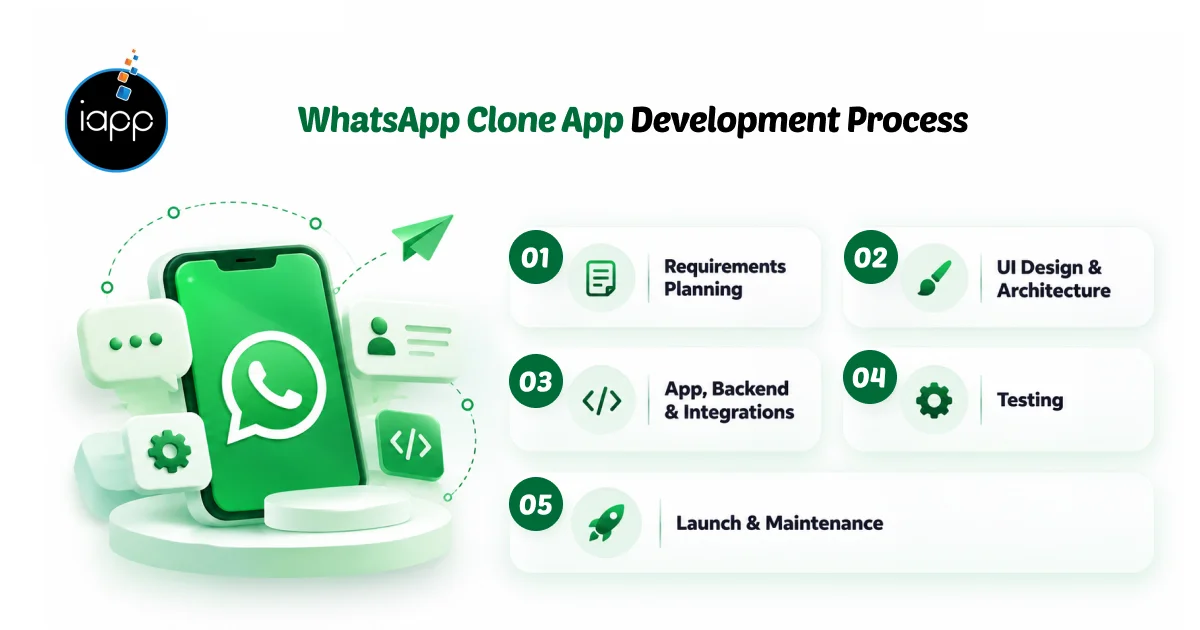
Here is how our WhatsApp clone development service works:
A business messaging app does not need to copy every WhatsApp feature. It can focus on a specific audience. For example, a service platform may need chat and booking features. A business platform may need CRM integration and admin controls. A community app may need moderation and member management.
This is where custom WhatsApp clone app development by iApp Technologies becomes useful. Our expert developers can shape your product around your users and business model.

The right WhatsApp clone development service partner should understand more than mobile interfaces. They should understand real-time communication, backend systems, APIs, security, and scaling. iApp Technologies can work around your product requirements. Our development approach can also support an MVP first. More features can then be added as the product grows.
A custom product gives you control over the core application. You can decide the branding, interface, features, integrations, and product roadmap. Also, it enables you to build around a specific business process. This makes WhatsApp Clone Development Service in the USA useful for companies with a clear communication use case.
A WhatsApp-like app can serve many business models. The key is to build around a clear user need. Start with your audience, core features, technology, and security requirements. Then decide whether an MVP or full product makes more sense. A reliable WhatsApp clone app development company in USA can help plan each stage.
iApp Technologies can help turn the concept into a custom messaging product. The result can include your branding, features, integrations, and product roadmap. We can also support you with testing, launch, and ongoing product updates.
A basic Minimum Viable Product (MVP) takes 10 to 14 weeks to build. A fully customized enterprise application with end-to-end encryption and WebRTC voice/video calling requires 24 weeks or more of engineering.
Yes, if built on a highly concurrent backend framework like Erlang or Elixir coupled with horizontal auto-scaling on cloud clusters. Utilizing persistent WebSocket connections ensures messages deliver with sub-100ms latency under heavy server loads.
A custom app grants your business 100% data ownership, infinite UI/UX customizations, and compliance with strict data frameworks (like HIPAA or GDPR). It also eliminates the ongoing per-message platform fees and template restrictions imposed by Meta.
Integrating high-quality audio and video via WebRTC protocols increases baseline development costs by $15,000 to $30,000. This covers specialized configuration for backend media streaming servers (like Janus) or third-party APIs (like Twilio).
Flutter and React Native are the top choices because they allow you to deploy to both iOS and Android from a single codebase. Flutter is generally preferred for chat apps due to its superior UI rendering speeds and smooth 60fps animations.
Secure your platform by integrating the open-source Signal Protocol (Double Ratchet Algorithm). This ensures that all message payloads are encrypted directly on the user’s device and can only be decrypted by the recipient, keeping your backend servers completely blind to data contents.
Yes, it is entirely legal as long as you write your own proprietary source code from scratch and design a unique user interface. You cannot copy or reverse-engineer Meta’s copyrighted code, trademarked logos, or brand assets.
For an early-stage app with low traffic, basic cloud infrastructure on AWS or Firebase costs $50 to $200 per month. As your active user base scales into the millions, high-concurrency server hosting, database management, and media delivery (CDN) costs can scale to $2,000+ per month.
 Jagwinder Singh
Wait! Before you go…
Talk to our experts and turn your ideas into powerful digital solutions.


 Trusted by 1000+ businesses

Fill out the form and our team will get back to you shortly.