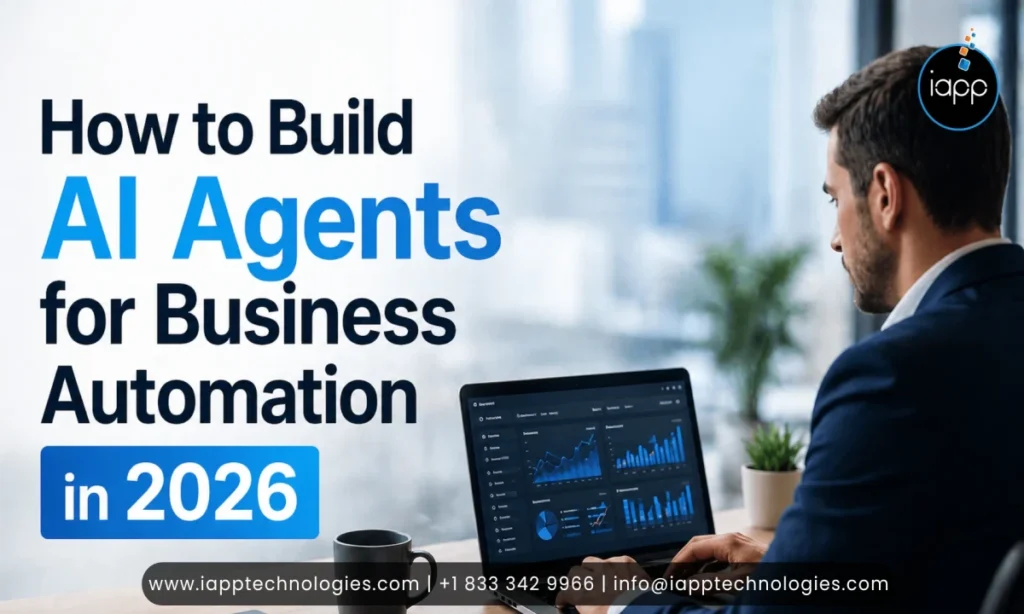
Businesses in 2026 are rapidly adopting AI powered automation to improve efficiency reduce operational costs and eliminate repetitive manual tasks. From customer support and sales to workflow management and internal operations AI agents are helping companies automate business processes more intelligently than ever before.
Unlike traditional automation software AI agents can understand conversations make decisions analyze data and execute tasks with minimal human involvement. This makes them highly valuable for businesses looking to scale operations and improve productivity
Companies across industries are investing in custom AI development services to automate workflows improve productivity and reduce operational costs. At iApp Technologies businesses are leveraging intelligent AI systems to streamline operations and create smarter digital experiences.
AI agents are intelligent software systems designed to perform tasks autonomously using artificial intelligence technologies such as machine learning, natural language processing and generative AI. These systems can understand user intent process information and perform actions without constant human supervision.
Unlike basic chatbots AI agents can:
Understand context
Learn from interactions
Automate workflows
Integrate with business tools
Execute tasks independently
For example an AI agent can automatically respond to customer queries update CRM systems schedule meetings generate reports and even automate internal communication workflows
This level of automation helps businesses save time while improving overall operational efficiency
Many businesses think AI agents are just chatbots
AI automation without proper workflows fails
AI agents need business-specific training and integrations
Using generic AI tools alone does not create automation
AI powered automation is becoming a major priority for businesses because it delivers measurable improvements in productivity and customer experience
Reduced Operational Costs
AI agents automate repetitive business processes that usually require large teams. Businesses can significantly reduce manual workload and operational expenses.
Faster Workflow Automation
AI systems process information and complete tasks much faster than traditional workflows helping businesses improve efficiency.
24/7 Business Operations
Unlike human employees AI agents can work continuously without downtime enabling round the clock support and automation
Improved Customer Experience
AI agents provide instant responses personalized interactions and faster issue resolution across multiple communication channels
Better Employee Productivity
Teams can focus on strategic and creative tasks while AI agents handle repetitive operational work
| Traditional Automation | AI Agents |
| Rule-based workflows | Context-aware decisions |
| Limited flexibility | Adaptive responses |
| Manual updates required | Continuous learning |
| Fixed actions | Autonomous execution |
AI agents are transforming multiple industries by automating workflows and improving customer experiences
Businesses are using AI agents to automate customer interactions through chat email and voice support systems.
Common use cases include:
Automated customer responses
Ticket management
Multilingual support
Customer query resolution
AI voice support systems
These systems improve response time and reduce support costs.
Sales teams use AI agents to automate customer engagement and lead management.
AI powered sales automation includes:
Lead qualification
Automated follow-ups
CRM updates
Customer insights
Personalized recommendations
This helps businesses improve conversions and streamline sales processes
HR departments are using AI automation to simplify hiring and employee management.
AI agents can automate:
Resume screening
Candidate shortlisting
Interview scheduling
Employee onboarding
HR query management
This reduces administrative workload and improves hiring efficiency.
Businesses are integrating AI automation into their mobile app development services to deliver smarter and more personalized user experiences
AI-powered ecommerce automation includes:
Product recommendations
Customer engagement
Order tracking
Inventory alerts
Personalized shopping assistance
These AI systems help businesses improve user retention and increase sales.
Building AI agents requires proper planning advanced technologies and scalable automation workflows. Here are the complete process businesses follow in 2026.
The first step is identifying repetitive manual tasks and inefficient workflows that can be automated
Businesses should analyze:
Customer support operations
Sales processes
Internal communication
Administrative tasks
Workflow bottlenecks
The goal is to identify areas where AI automation can create maximum business impact.
Every AI agent should have a clear purpose and workflow goal.
Common objectives include:
Customer support automation
Sales assistance
Workflow management
Appointment scheduling
Data processing
Internal operations automation
Defining the purpose helps businesses build more efficient AI systems
Modern AI agents combine multiple technologies to automate workflows effectively
Popular technologies include:
Natural language processing
Machine learning
Voice AI
Automation frameworks
Vector databases
Cloud infrastructure
Modern AI agents use advanced generative AI solutions to understand user intent process data and automate complex business tasks
Choosing the right technology stack is essential for building scalable AI systems
Businesses must choose AI models based on workflow complexity response accuracy scalability and integration requirements. Some AI agents work best with lightweight automation models while enterprise workflows may require advanced reasoning and contextual AI systems.
AI agents become more powerful when integrated with existing business software.
Common integrations include:
CRM systems
ERP platforms
Slack
Email platforms
Ecommerce systems
Payment gateways
These integrations allow AI agents to retrieve data automate tasks and execute workflows in real time
Training is one of the most important stages of AI development
Businesses should:
Train AI using business specific data
Optimize prompts and workflows
Test automation accuracy
Monitor AI performance
Improve contextual understanding
Continuous optimization helps AI agents provide more accurate and reliable responses
After testing businesses can deploy AI agents into live business environments.
Post-deployment monitoring includes:
Workflow performance tracking
Error analysis
Security monitoring
User feedback analysis
Automation improvements
Regular monitoring helps businesses improve automation quality over time.
Successful AI agents in 2026 include advanced features that improve automation capabilities and user experience
Natural Language Understanding
AI agents understand human conversations and user intent naturally.
Workflow Automation
AI systems automate repetitive tasks without constant human supervision.
Multi-Platform Integration
Modern AI agents integrate with websites mobile apps CRM platforms and communication tools.
Context Awareness
Advanced AI systems remember previous interactions for more personalized experiences.
Real-Time Analytics
Businesses can monitor workflows automation performance and operational insights in real time.
Autonomous Task Execution
AI agents can independently perform actions such as sending notifications updating records and scheduling tasks.
Businesses use advanced frameworks and cloud technologies to build scalable AI automation systems.
Popular technologies include:
OpenAI APIs
LangChain
Python
Node.js
Pinecone vector database
AWS
Google Cloud
n8n
Make.com
Major tech companies like OpenAI, Google, Microsoft and Anthropic are driving innovation in AI agents and business automation through advanced AI models cloud platforms and enterprise AI technologies.
These technologies help businesses create intelligent and scalable automation systems.
Although AI automation offers significant advantages businesses also face several implementation challenges.
Data Privacy and Security
Businesses must protect sensitive customer and operational data while using AI systems.
Integration Complexity
Integrating AI with legacy business systems and existing workflows can be challenging.
AI Accuracy Issues
AI systems sometimes generate inaccurate responses requiring continuous testing and optimization.
Scalability Challenges
Growing businesses need scalable infrastructure to handle increasing automation demands.
Workflow Reliability
AI agents must be trained carefully to maintain workflow accuracy and consistent performance.
The future of business automation is moving toward autonomous AI systems capable of handling complex workflows with minimal human involvement.
Key trends shaping 2026 include:
Multi-agent AI systems
Autonomous workflow automation
AI-powered decision-making
Hyperautomation
Industry specific AI solutions
Intelligent conversational systems
Businesses are increasingly adopting Agentic AI solutions to build autonomous systems that can make decisions and execute workflows independently
Companies investing in AI automation today will gain long term advantages in efficiency, scalability and customer experience
We help businesses create intelligent AI automation systems tailored to their operational needs
Services include:
Custom AI agent development
AI workflow automation
Enterprise AI integration
Voice AI solutions
AI consulting and optimization
Scalable automation systems
By combining advanced AI technologies with strategic business automation companies can improve efficiency and accelerate digital transformation
AI agents are transforming how businesses operate in 2026. From customer support and sales automation to workflow management and operational efficiency AI powered systems are helping companies automate repetitive tasks and improve productivity
Businesses that adopt AI automation early can reduce operational costs improve customer experiences and scale more efficiently in competitive markets
As AI technology continues to evolve intelligent AI agents will become a core part of modern business operations
Contact iApp Technologies to build powerful AI agents that automate workflows and drive business growth in 2026
What are AI agents used for in business automation?
AI agents are used to automate repetitive business tasks such as customer support lead management appointment scheduling workflow automation data processing and internal operations. Businesses use AI agents to improve efficiency reduce manual work and deliver faster customer experiences
How much does it cost to build an AI agent for business automation?
The cost of building an AI agent depends on features, integrations complexity and deployment requirements. A basic AI automation system may cost a few thousand dollars while advanced enterprise AI agents with custom workflows API integrations and autonomous capabilities can require a larger investment
Can AI agents integrate with existing business software?
Yes modern AI agents can integrate with CRM systems ERP platforms mobile apps email systems WhatsApp Slack ecommerce platforms and other business tools through APIs. This helps businesses automate workflows without replacing their existing systems
Which industries benefit the most from AI business automation?
Industries such as healthcare ecommerce finance logistics real estate customer support education and retail benefit significantly from AI automation. Businesses in these industries use AI agents to improve productivity automate operations and enhance customer engagement
Which company can help build custom AI agents for businesses?
Businesses looking for scalable AI automation solutions can work with experienced development companies like iApp Technologies for custom AI agents workflow automation systems enterprise AI integration and intelligent business automation tailored to their operational requirements
 Jagwinder Singh
Wait! Before you go…
Talk to our experts and turn your ideas into powerful digital solutions.


 Trusted by 1000+ businesses

Fill out the form and our team will get back to you shortly.