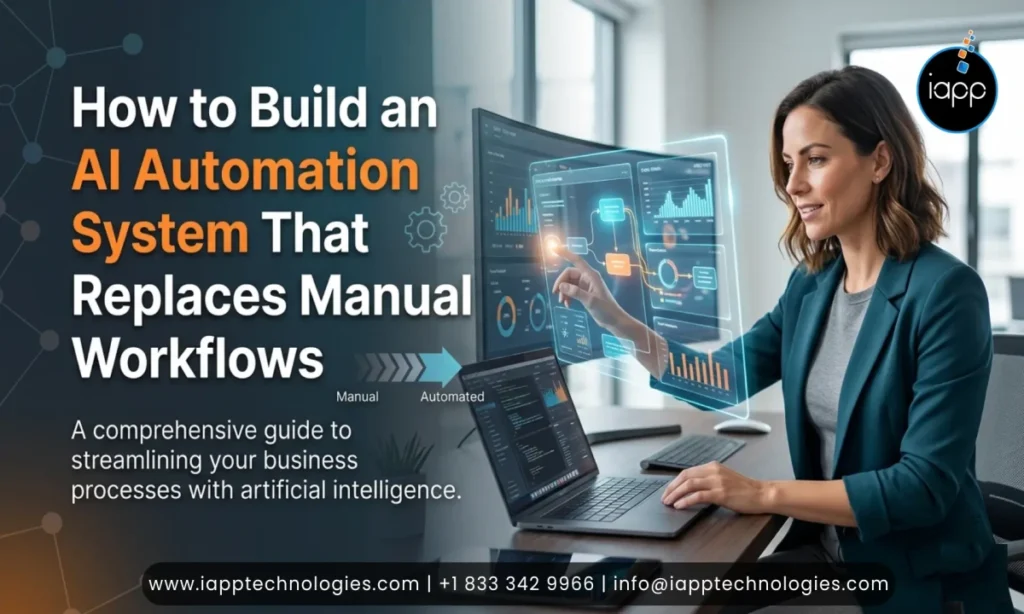
Manual workflows are one of the biggest productivity killers in modern businesses. From repetitive data entry to handling customer queries relying on manual processes increases operational costs slows down efficiency and often leads to human errors
This is why businesses are rapidly shifting toward AI workflow automation systems. By leveraging intelligent automation companies can streamline operations reduce workload and improve accuracy at scale. At iApp Technologies we don’t just add tools we build AI systems that fix your slowest tasks and turn them into fast, scalable growth.
In this guide, you’ll learn how to build an AI automation system step by step key tools to use and how to successfully replace manual workflows with smart automation.
An AI automation system combines artificial intelligence with workflow automation to perform tasks that typically require human intervention. Unlike traditional automation which follows fixed rules AI automation can analyze data learn patterns and make decisions. Modern businesses now use Intelligent Process Automation (IPA) to create smarter and more adaptive workflows
Automation vs AI Automation
Example
Quick Summary: AI automation doesn’t just automate tasks it improves how work gets done
Reduce Operational Costs
Manual processes require significant time and workforce. Manual task automation using AI reduces dependency on repetitive human tasks.
Improve Efficiency and Speed
AI systems can process large amounts of data instantly significantly reducing turnaround time.
For example instead of manually checking every sales lead AI instantly identifies high-value customers helping businesses increase conversions by up to 30%.
Minimize Errors
Human errors can impact business performance. AI ensures higher accuracy and consistency.
Enable Scalability
AI systems can handle growing workloads without increasing operational costs
Quick Summary: AI replaces slow manual work with intelligent systems that scale faster
AI automation can be applied across multiple business functions:
These use cases are becoming essential for businesses investing in enterprise AI solutions
Step-by-step guide to replacing manual data entry with AI
Start by identifying processes that are repetitive time consuming and rule based. These are ideal candidates for automation
Set measurable goals such as:
Selecting the right tools is critical. Businesses often rely on professional AI development services to build customized automation systems tailored to their needs. Use Zapier for quick and simple automations but choose UiPath for enterprise level workflows that require advanced scalability and security
n8n vs. Make.com vs. Zapier for ai agents 2026

No-code AI automation platforms are also helping businesses deploy automation faster without heavy technical expertise.
Map out your workflow including inputs outputs and decision points. This ensures a smooth automation process
Train your AI models using relevant data and integrate them with existing systems such as CRM or ERP platforms
How to integrate ChatGPT API into business workflows?
Run pilot tests identify gaps and continuously optimize your automation system for better performance
Quick Summary: The right workflow and tools can save businesses hundreds of manual work hours every month
Choosing the right tools is essential for building a scalable AI automation system. These tools help automate repetitive tasks and improve overall efficiency
Popular AI Automation Tools:
These are considered some of the Best AI automation tools 2026 for startups and enterprises.

Choosing the right AI automation tool depends on your business size goals and complexity of workflows. Start with scalable solutions and upgrade as your automation needs grow to maximize long term ROI
The cost varies depending on the complexity and scale of the solution:
Factors affecting cost include workflow complexity integrations data requirements and development expertise. Many businesses also prefer to hire mobile app developers for custom AI automation systems that integrate smoothly with existing apps and platforms.
Your data is 100% safe.
We use advanced encryption systems, secure cloud infrastructure and follow global privacy standards to protect sensitive business information.
This ensures businesses can automate workflows confidently without compromising security.
Quick Summary: Smart automation should always include enterprise grade security.
Avoiding these mistakes ensures a smoother automation journey.
iApp Technologies helps businesses build intelligent AI automation systems tailored to their needs.
What You Get:
We use Agentic AI and Hyperautomation strategies to create systems that can analyze, decide and optimize workflows automatically.
Their team ensures that your automation system delivers measurable business outcomes and long term growth.
AI automation is evolving rapidly with new trends shaping the future:
Businesses adopting these technologies early gain a significant competitive advantage
AI automation is no longer a luxury it’s a necessity for businesses aiming to stay competitive. By replacing manual workflows with intelligent systems you can improve efficiency reduce costs and scale your operations faster
Stop wasting time on repetitive manual work. Contact iApp Technologies for a free workflow audit and discover how AI caon transform your business operations
How do I know if my business needs AI automation?
If your team spends significant time on repetitive tasks like data entry customer support or manual reporting it’s a strong sign your business can benefit from AI automation
What type of workflow should I automate first?
Start with high volume repetitive and rule based processes such as customer support invoicing lead management or data processing.
How much does it cost to build an AI automation system?
The cost depends on workflow complexity, integrations and customization. Basic systems may start from $5,000 while enterprise grade automation can exceed $50,000
Can AI automation integrate with existing software?
Yes. AI automation systems can integrate with CRM ERP and marketing platforms to streamline operations without disrupting existing workflows.
Who should I hire for AI automation development?
Businesses should work with experienced AI automation experts like iApp Technologies to ensure scalable secure and future ready automation systems.
 Jagwinder Singh
Wait! Before you go…
Talk to our experts and turn your ideas into powerful digital solutions.


 Trusted by 1000+ businesses

Fill out the form and our team will get back to you shortly.