
A taxi business can have drivers and customers but still lose bookings without a reliable digital platform. A Lyft clone app brings booking, driver matching, GPS tracking, payments, and ride management into one system.
For businesses planning Lyft clone app development, the goal is not to copy Lyft’s branding or design. It is to build a customized ride-hailing platform around your own market, operations, pricing, and customer experience. Lyft reported 945.5 million rides in 2025, up 14% year over year, showing the scale that modern ride-hailing platforms can support. This guide covers the core features, technology, development cost, monetization, US launch considerations, and development process.
A Lyft clone app is a customized ride-hailing platform based on the core operating model of services such as Lyft.
It connects three primary systems:
For taxi companies and fleet operators, this model can replace fragmented phone-based or manual booking processes with one centralized system.
A clone should not mean copying Lyft’s source code, branding, or protected interface. Instead, Lyft clone app development should adapt proven ride-hailing workflows to your own business.
A ride starts when a customer enters a pickup location and destination. The platform then calculates the estimated fare, finds eligible drivers, manages the trip, and processes payment after completion.
A typical ride lifecycle includes:
This makes ride-sharing app development more complex than a standard booking application because several systems must communicate in real time.
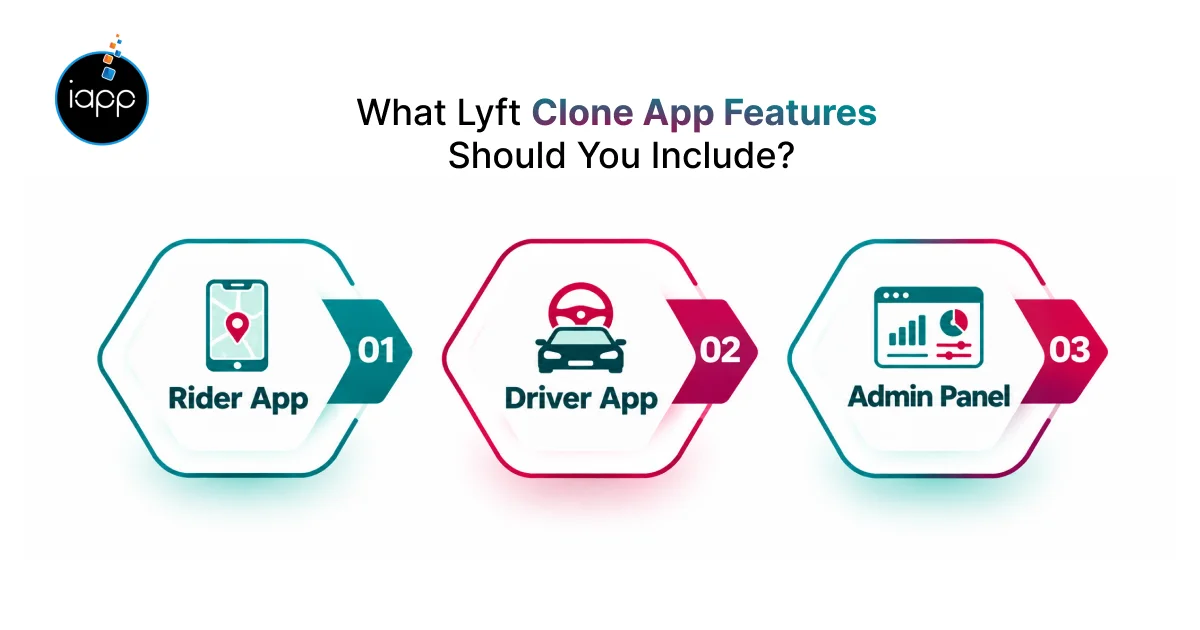
The right Lyft clone app features depend on your target market and business model. For an MVP, prioritize the functions required to complete a ride reliably.
| Rider app | Book rides | Booking, tracking, payment |
|---|---|---|
| Driver app | Complete rides | Requests, navigation, earnings |
| Admin panel | Manage operations | Dispatch, pricing, analytics |
For taxi booking app development, keeping these three systems synchronized is essential.
The Lyft clone app development cost can range from approximately $40,000 to $160,000+, depending on the product scope, integrations, platforms, and level of customization.
| Development level | Estimated cost | Estimated timeline |
|---|---|---|
| MVP | $40K–$80K | 3–5 months |
| Market-ready | $80K–$160K | 5–8 months |
| Advanced platform | $160K+ | 8–12+ months |
The final cost depends on factors such as:

The ride-hailing app development cost also rises when you add multi-city operations, corporate accounts, advanced analytics, fleet management, or AI-powered capabilities.

A scalable technology architecture keeps bookings, location updates, payments, and notifications synchronized.
A practical stack can include:
For Lyft clone app development, the backend should handle critical business logic rather than relying on the mobile application.
For example, driver matching, fare calculation, trip status, payment confirmation, and cancellation rules should remain controlled by the backend.
A ride-hailing platform can combine several revenue streams.
Common models include:
Start with one or two revenue models during the MVP stage. Too many fees can make customer acquisition and driver retention harder.
A practical approach is to track ride volume, average booking value, commission, driver incentives, cancellations, and payment costs before expanding the pricing model.

A Lyft clone app development USA project needs market-specific planning because transportation requirements can differ between states and cities.
The US Bureau of Labor Statistics states that regulations for ride-hailing drivers vary by state and city. It also reports approximately 204,200 taxi-driver jobs in 2025.
Before launch, businesses should review:
Compliance should be considered during product planning rather than added after development.
The best approach is to validate one market first and expand after the core marketplace proves itself.
A practical how to develop a Lyft clone app roadmap is:

Our approach to Lyft clone app development is to prioritize the core marketplace before secondary features.
A visually polished rider app will not compensate for slow driver matching or unreliable GPS updates. The underlying ride lifecycle should work consistently before adding advanced functionality.
Focus first on:
Once these workflows are stable, features such as subscriptions, corporate accounts, AI analytics, and advanced loyalty programs can be introduced based on actual market demand.

At iApp Technologies, we build custom transportation products around the client’s operating model instead of treating every project as the same app template.
We first define:
This helps establish what needs to be built before development resources are allocated.
We can plan the architecture around:
This gives the product room to expand without rebuilding its core architecture.
Our development process can include:
For businesses looking for a Lyft clone app development company USA, iApp Technologies offers custom mobile and software development capabilities focused on scalable architecture, integrations, and long-term product development.
Successful Lyft clone app development is about building a reliable transportation marketplace, not simply reproducing another app’s interface. A focused MVP, real-time infrastructure, secure payments, scalable architecture, and market-specific planning provide a stronger foundation for growth.
iApp Technologies can help businesses plan, develop, test, and scale custom ride-hailing platforms around their specific business model and target market.
Yes. You can create your own branding, interface, workflows, features, and customer experience while using a similar ride-hailing business model.
A focused MVP typically takes 3–5 months, while an advanced multi-city platform can require 8–12+ months.
Yes. A scalable platform can support different service zones, pricing rules, fleets, drivers, and city-level operational reporting.
Yes. Scheduled rides can support advance bookings, reminders, driver assignment, notifications, and cancellation rules.
Yes. Fleet management can handle vehicles, drivers, assignments, documents, earnings, and operational performance.
A platform can support cards, digital wallets, saved payment methods, refunds, tips, and other payment options supported by the selected gateway.
Yes. AI can support demand forecasting, driver matching, fraud detection, customer support, route optimization, and operational analytics.
Compare transportation experience, architecture, security practices, ownership terms, development methodology, support, and transparent project estimates.
 Jagwinder Singh
Wait! Before you go…
Talk to our experts and turn your ideas into powerful digital solutions.


 Trusted by 1000+ businesses

Fill out the form and our team will get back to you shortly.