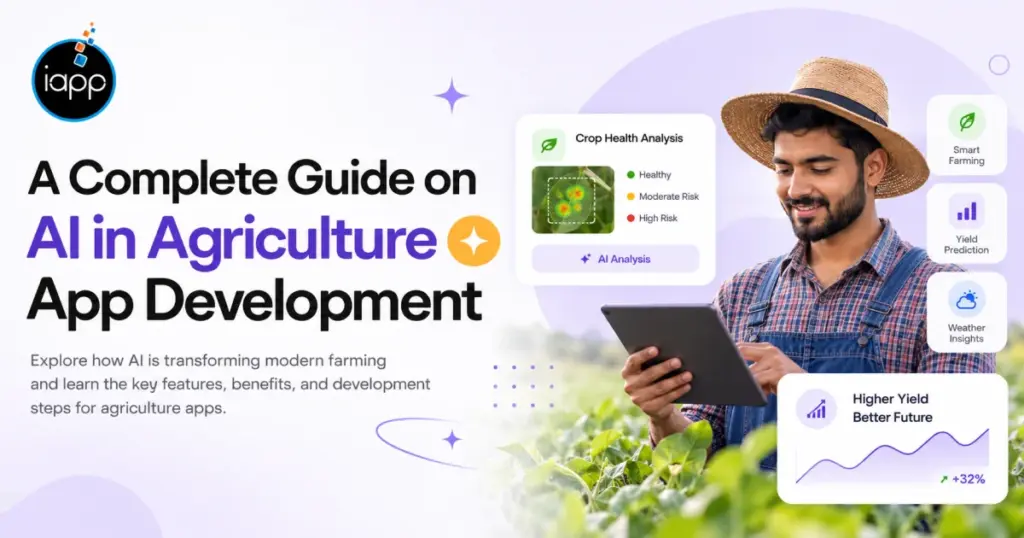
A farm manager examines crop, soil, and meteorological data independently. As a result, decisions are delayed, and needless operating expenses may rise. These data points can be combined by an AI-powered app.
Farm data, AI, sensors, maps, and APIs are all integrated by AI agriculture app development. It assists businesses to make the right decisions on time. In this guide, we will cover features, technology, expenses, schedules, and development processes.
Software for agricultural decision-making is built via AI agriculture app development.
Data is gathered by the app from many agricultural sources. After analyzing the data, AI makes helpful recommendations. These applications have access to several data sources, such as:
After that, the app can recognize patterns and send alerts. For instance, it can pinpoint potential agricultural stress. It could also indicate when irrigation needs maintenance. This increases the practicality of AI in agricultural app development.
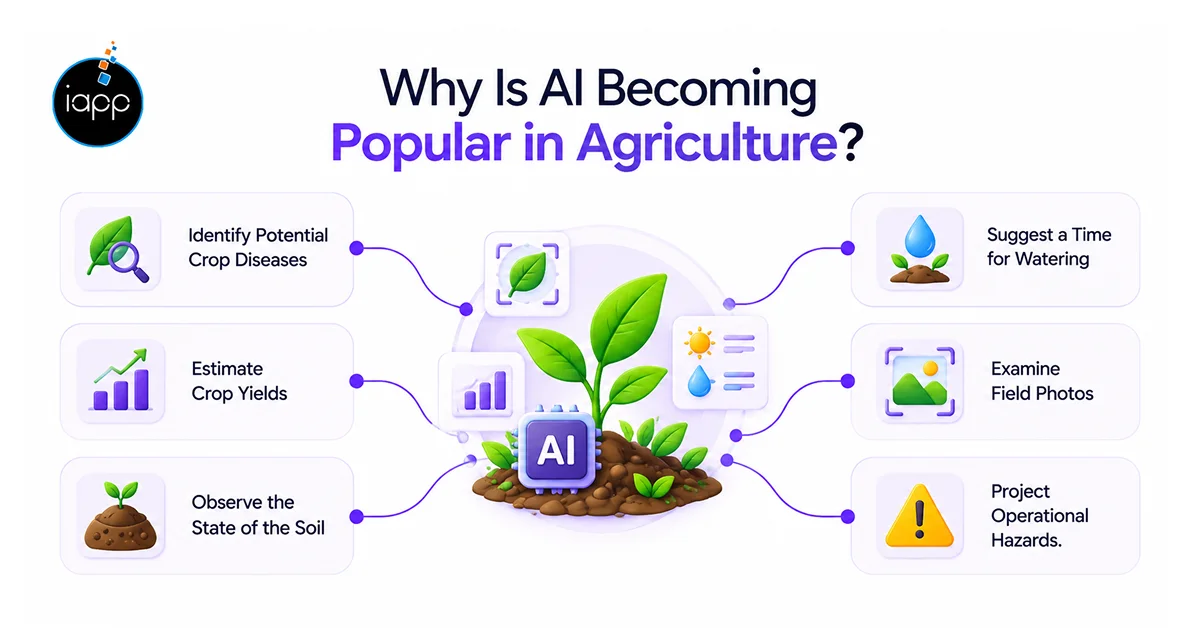
More data is now managed by farm enterprises. However, a large portion of that data is still segregated. AI is able to link those signals and make decision-making easier.
In 2026, McKinsey conducted a poll with 5,500 farmers in 10 different nations. 17% of farmers employ generative AI, according to the study. Some of the greatest adoption rates were seen in North America.
The USDA says that modern agriculture uses robotics, sensors, GPS, and aerial photos. Modern American farming is already supported by these technologies. AI gives these tools an additional layer of decision help.
Farmers can use AI, for instance, to:
Numerous farm operations may be supported by an AI agriculture app. Its capabilities depend on data and business requirements.
Crop photos can be analyzed using computer vision. Visible signs of illness can be flagged by the system. After that, the app can alert users for further examination.
Location-specific conditions can be gathered via weather APIs. Soil sensors are used to measure moisture in soil. These two signals are combined by AI to provide irrigation recommendations.
Yield and Crop Prediction
Production data from the past may be analyzed via machine learning. It is able to recognize trends associated with earlier yields. Forecast ranges may then be obtained from the app.
Farm Operations and Decision Support
Important agricultural signals might be shown together on a dashboard. Field conditions, tasks, and alarms may all be reviewed by managers. Actions in various domains can then be prioritized.
Sensors, drones, satellites, and machine learning are already being used in USDA-funded research. These systems can suggest specific fertilization or irrigation. That gives AI farming app development a practical direction.
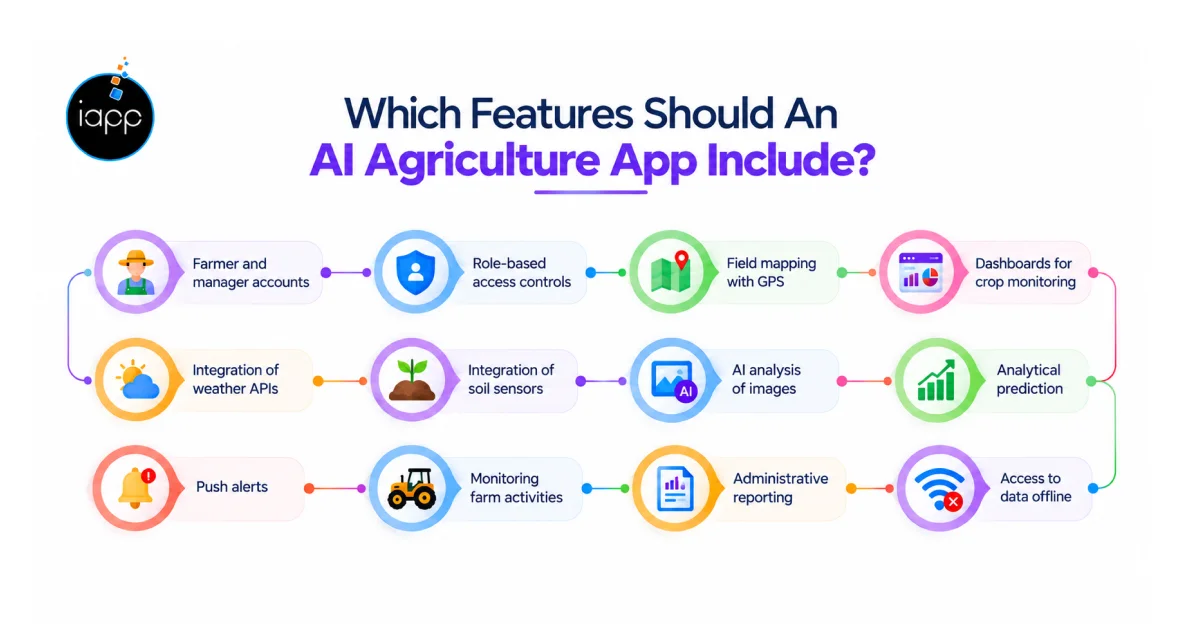
Your users and farm model will determine which features are best. A powerful product, however, may be supported by several capabilities.
The right features depend on your users and farm model.
However, several capabilities can support a strong product.
Key characteristics may consist of:
Smart farming app development also needs simple interfaces. Farm workers may use the app outdoors. They may also work with limited connectivity. So, the interface should remain quick and clear.
Successful apps start with a clear agricultural issue. That specific requirement should then be followed by the development process.
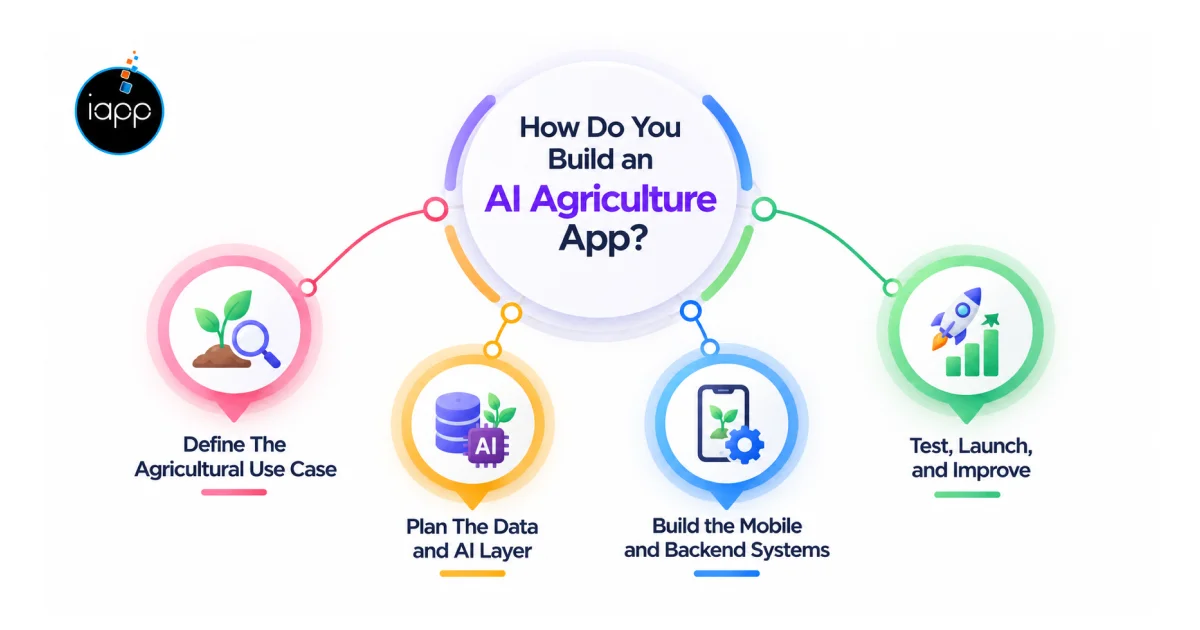
Start with a single business issue. For instance, concentrate on identifying agricultural diseases. Don’t develop every feature in the initial release.
Determine the information needed for every feature. Sensors, photos, weather, and agricultural records are examples of sources.
Among the potential technologies are:
Python for machine learning applications
This forms the foundation of AI agriculture software development.
Farmers’ interactions are managed using the mobile app. Users, data, and business logic are all managed by the backend. AI services analyze data and produce insightful outcomes.
For agriculture mobile app development, teams can use:
Agriculture app development cost depends on scope as well as technical complexity.
The budget is increased via AI, sensors, maps, and other integrations.
| App Type | Estimated Cost | Timeline | Typical Scope |
|---|---|---|---|
| Basic MVP | $30K-$60K | 3-4 months | Weather, records, alerts |
| AI-enabled App | $60K-$120K | 4-6 months | AI insights, dashboards |
| Advanced Platform | $120K-$250K+ | 6-9+ months | AI, GIS, IoT, analytics |
These numbers are not fixed quotations; rather, they represent planning ranges. Your product specifications will determine the final estimate. Initial development expenses can be decreased with a targeted MVP. Additionally, it provides teams to analyze the market.
Technical characteristics alone are not enough for US agribusiness enterprises. The product needs to be compatible with actual farm activities.
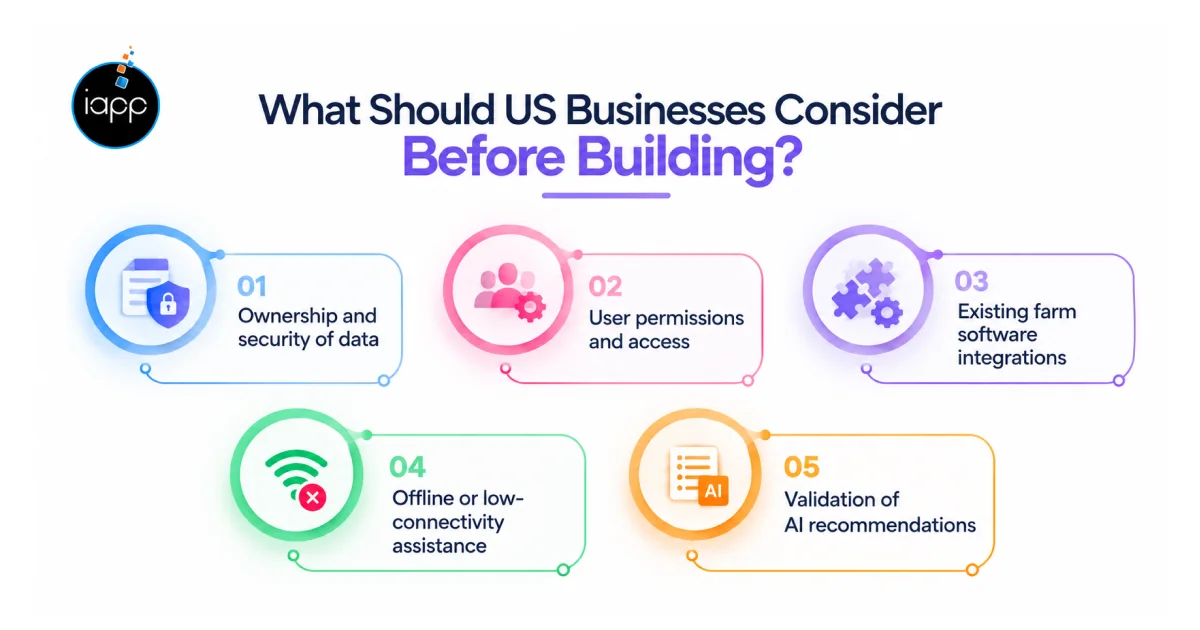
Prior to construction, take into account following areas:
Expert insight: Start with measurable farm outcomes.
For example, first target lower water usage. Then build advanced features around that result.
This approach makes precision agriculture app development more focused. Additionally, it facilitates the measurement of product performance.
We develop agricultural apps based on specific business needs. Our strategy emphasizes scalable technology and practical features.
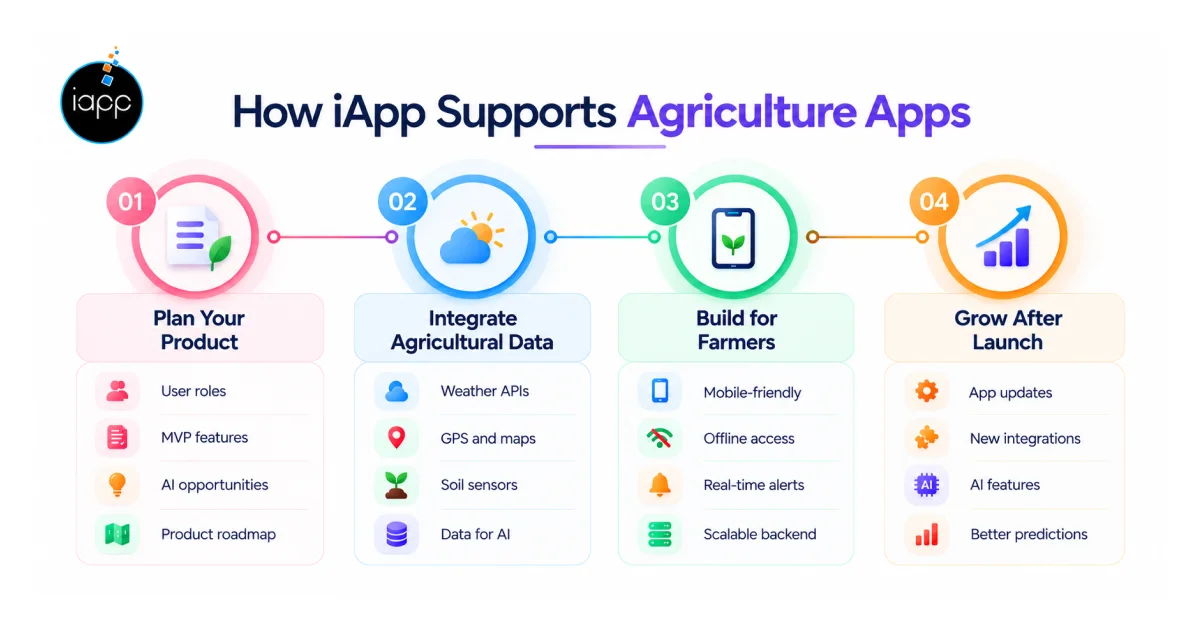
We start by making your product and users clear. Next, we outline the main agricultural processes.
Our preparation includes:
This lessens the amount of needless development labor.
Our team can integrate several data sources. Weather, maps, sensors, and external APIs are a few examples. Additionally, we can organize data for future AI capabilities. This makes future product expansion easier.
Applications for farms must have easy-to-use interfaces. We prioritize quick decisions and clear information.
Our team can support:
After the first release, our involvement can continue. We can help with updates, integrations, and technological advancements. Future AI capabilities can also be planned with our assistance. That includes predictive tools and intelligent recommendations.
In case you are looking for a reliable agriculture app development company USA , iApp Technologies can help.
Apps for agriculture are using AI, mobile tools, and data these days. Practical agricultural decisions are imperative to develop the best product.
Custom software is created by iApp Technologies to meet complex business requirements. We can assist you in turning your agricultural concept into a powerful app.
AI analyzes farm data and identifies useful patterns. It can support crop, irrigation, weather, and resource decisions.
Yes, apps can connect with compatible IoT devices. Sensor data can support real-time monitoring and recommendations.
Yes, satellite imagery can support field monitoring. It can help analyze crop health and vegetation patterns.
Common options include computer vision and machine learning. Predictive models can also support forecasting and recommendations.
Accuracy depends on training data and field conditions. Human validation remains important for critical farming decisions.
Yes, models can be trained for specific crops. Crop-specific data can improve relevant recommendations.
A basic MVP can take three to four months. Advanced platforms may require six to nine months.
Common models include subscriptions and enterprise licensing. Premium analytics and marketplace fees are also possible.
 Jagwinder Singh
Wait! Before you go…
Talk to our experts and turn your ideas into powerful digital solutions.


 Trusted by 1000+ businesses

Fill out the form and our team will get back to you shortly.