
Guide to Uber App Development Cost – Ride-hailing is no longer a side gig. According to the Fortune Business Insights report, it is projected to increase from $284.74 billion in 2025 to $315.49 billion in 2026, with a CAGR of 10.8%. With such huge growth, many founders and even transport companies ask the same question: What is the real Uber app development cost?
We’ll discuss down-pricing, features, timelines, and the true elements that bring your budget up or down in this guide. Knowing all these aspects, you may design your app without any guessing.
Building a functional ride-hailing app will likely cost between $25,000 – $150,000. But the exact pricing will vary with features and the region of your development team. A simple MVP with rider and driver apps, GPS monitoring, and payment connection is inexpensive. On the other hand, a full platform with AI dispatch, live analytics, and multi-city support can cost around $100,000.
Most agencies charge hourly for tasks, not a set amount. There is a huge difference in this aspect. A US-based team bills approximately. $100 to $180 an hour. Whereas a team working in India typically charges between $25 to $50 an hour, even for the same feature list.
Besides app screens, there are a lot of elements that impact the cost of Uber app development. Here are the major ones:
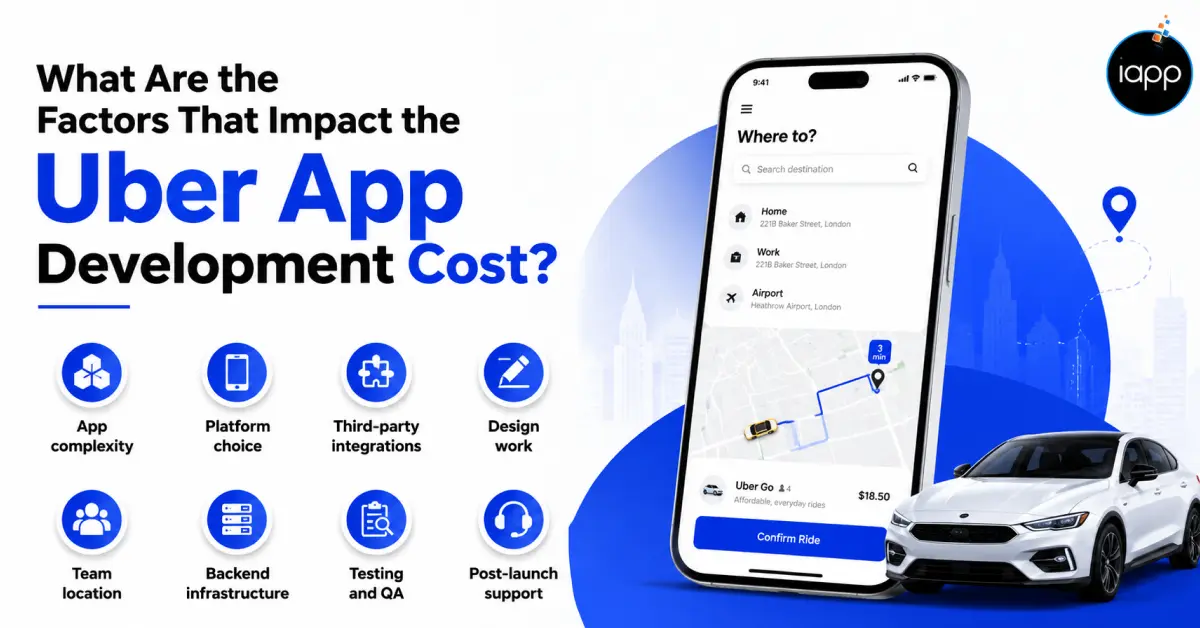
Overlooking any of these during planning is the most common reason projects go over budget.
Here is a simple table showing how cost scales with app complexity. Figures reflect typical US market rates for 2026.
| App Tier | Core Features | Estimated Cost | Timeline |
|---|---|---|---|
| Basic MVP | Rider app, driver app, GPS tracking, basic payments | $15,000 – $45,000 | 3 to 4 months |
| Mid Level | Above plus in app chat, ratings, fare estimator, admin dashboard | $50,000 – $90,000 | 5 to 7 months |
| Advanced Platform | Above plus AI dispatch, surge pricing, multi city support, analytics | $100,000 – $180,000+ | 8 to 12 months |
The price of a taxi booking app development for a single city launch is usually moderately priced. On the other side, a nationwide platform requires advanced tier funding.
Get a real cost estimate from iApp Technologies, based on your features, not a generic calculator.
Although the two terms are used interchangeably quite often, there is a difference. Taxi app development cost is generally related to a basic booking and dispatching methodology associated with a licensed fleet. On the other side, the ride sharing app development cost also covers the peer-to-peer driver onboarding, dynamic pricing, and wider compliance work across states or nations.
A city taxi operator digitizing an existing fleet usually launches for less in comparison to a startup establishing a ride-sharing network from scratch. That’s because the cab owner already has the drivers, the cars, and the local permits to go.
Uber app development costs in USA projects average higher than offshore builds. This is because of expensive labor. US dev hourly rates range between $80 to $200, as per Clutch’s 2026 agency rate data. At the same time, developers in South Asia or Eastern Europe charge between $25 to $60.
If you don’t have a budget constraint, partnering with a taxi app development company in the USA is a good option. But in another case, the cost to build an Uber like app in US can be reduced by hiring an overseas team. You can also go with the hybrid workforce option to stay compliant with the local rules and regulations.
Launching the app is just a step one. Uber app development cost per month for upkeep, servers, and support typically runs $2,000 to $8,000.
Recurring costs include:
If you are budgeting for the year, it’s better to include these recurring line elements along with the initial build.
Yes, a clone or white label solution is typically less expensive than a fully custom build. Uber clone app development cost ranges from $15,000 to $40,000. This is because the core codebase is already there. Only branding, minor features, and integrations need customization.
The problem is flexibility. Clone solutions are faster to launch but harder to scale with unique features later. Therefore, they suit founders testing a local market before committing to a custom build.
Most ride-hailing apps fail from missing features, not bad ideas. iApp Technologies’ mobile app developers turn your idea into a clear build plan before a single line of code is written.
The Uber app development cost relies a lot on your feature list, your target market, and the location of your development team. Launching a basic MVP costs less than $50,000, but a full-featured dispatch platform with AI and multi-city capability might be more than $150,000. Understanding these Uber-like app development costs upfront assists you in planning a realistic budget.
iApp Technologies is a US-based mobile app development company. We have hands-on experience in building ride-hailing and on-demand apps. In case you are ready to move from planning to building, reach out to us. Our expert dev team will provide a project estimate tailored to your market and features.
Get Your Free Project Estimate →
Typically, the cost of a working app like Uber may be anywhere from $25,000 to $150,000. However, the exact price depends upon the features, platforms, and location of the development team.
Development for a full-featured platform from a US-based company will usually cost $80,000 to $180,000. This is because of higher local developer hourly rates.
Yes, clone scripts often run $15,000-$40,000. But it offers less flexibility for custom features and long-term growth.
A simple MVP takes 3 to 4 months. On the other hand, a comprehensive platform with extensive capabilities might take 8 to 12 months.
The cost of ride sharing app increases because of AI-based dispatch, real-time surge pricing, multi city support, and sophisticated analytics.
Yes. Any ride-hailing platform in working mode has three basic parts: passenger app, driver app, and admin dashboard. And all these components needed to be functional.
The monthly costs of running are typically between $2,000 – $8,000. It includes hosting, APIs, payment processing and support staff.
The main factors affecting the budget are: app complexity, third-party integrations, platform, and the development team’s hourly rate.
Yes. Because taxi apps are already linked to licensed fleets, they need fewer drivers to join and less pricing logic.
Choose a business like iApp Technologies. We have a proven record of ride-hailing case studies, expertise in US compliance, and post-launch assistance.
 Jagwinder Singh
Wait! Before you go…
Talk to our experts and turn your ideas into powerful digital solutions.


 Trusted by 1000+ businesses

Fill out the form and our team will get back to you shortly.