
Looking to develop a taxi booking app for Dubai or the wider UAE? The opportunity is excellent. Dubai recorded 120.1 million taxi trips in 2025, of which 45% were handled by e-hail.
Hala is a strong example of how digital taxi booking can connect riders with taxis easily. If you want to build a similar service, this guide explains how to make an app like Hala Taxi. From key features and technology to development costs and UAE-specific requirements, this guide covers it all.
Hala combines taxi booking with real-time digital tools through the Careem app. RTA and Careem launched Hala as a taxi e-hailing service in Dubai. Users can enter pickup and drop-off points. They can then select a car type and payment method. The app also shows an estimated fare before booking.
Hala also supports scheduled rides for selected services in Dubai. This model shows what businesses need when planning Hala taxi app development.
A Hala-style app connects passengers, drivers, dispatch systems, payments, and administrators.
The booking process should stay simple from pickup selection to trip completion.
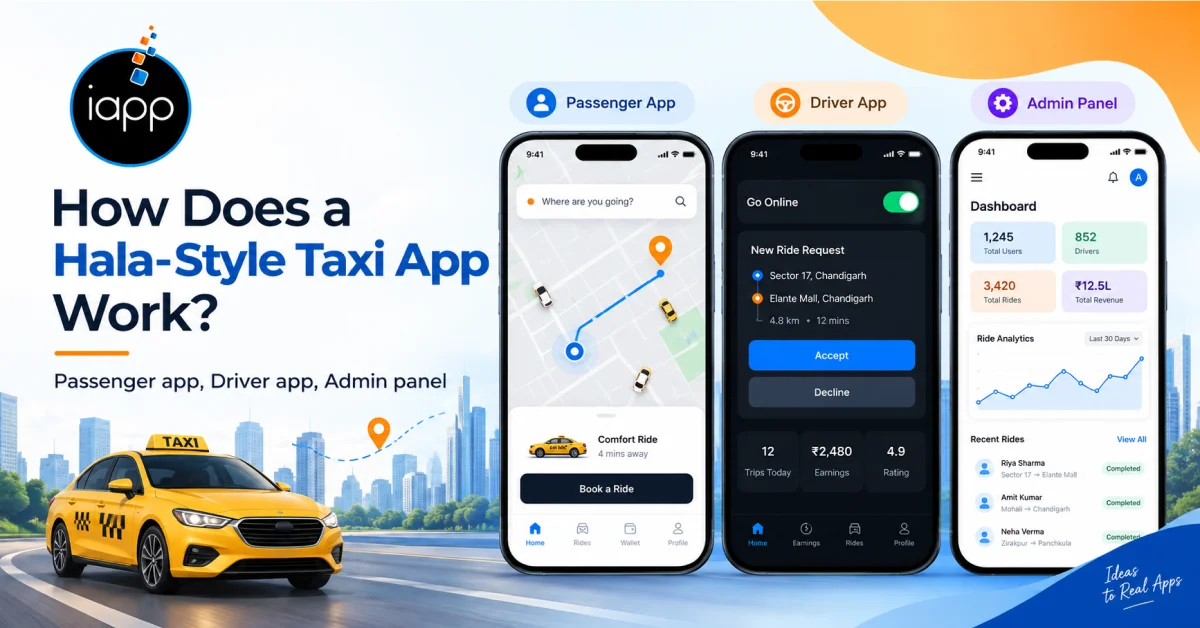
Passenger app
Driver app
Admin panel
The technology should support live location, secure payments, notifications, and high booking volumes.
For taxi app development in Dubai, the architecture should also support local business requirements.
| App Component | Suitable Technology |
|---|---|
| iOS app | Swift or Flutter |
| Android app | Kotlin or Flutter |
| Backend | Node.js, Python, or Laravel |
| Database | PostgreSQL or MySQL |
| Maps | Google Maps or Mapbox |
| Real-time tracking | WebSockets |
| Notifications | Firebase Cloud Messaging |
| Admin panel | React or Next.js |
| Cloud | AWS, Azure, or Google Cloud |
The final stack depends on your features, budget, expected users, and integration requirements. For taxi app development in the UAE, businesses should also plan payment, identity, location, and data security requirements early.
A clear development process reduces errors later. For taxi booking app development, the project should move from planning to testing in defined stages.

First, service model, users, locations, fleet structure, and booking rules are defined. Also decide whether you need an MVP or a full platform.
Then passenger, driver, and admin interfaces are created. Booking, tracking, payment, cancellation, and support screen mapping are done before coding.
Development of the mobile apps, backend, APIs, database, and admin dashboard takes place. Payment, maps, notifications, and tracking are integrated during this stage.
Testing of bookings, GPS accuracy, payments, notifications, account security, and driver workflows is carried out. Real-device testing should also cover different screen sizes and operating systems.
The app store releases as well as production infrastructure preparation is done. After launch, eyes are kept on performance, fixing issues and adding features based on actual usage.
The taxi app development cost in Dubai depends on app scope, integrations, design, and platform requirements. A basic MVP costs less than a multi-role platform with advanced dispatch and analytics.
For planning purposes, a custom project can fall within these ranges:
| Development Level | Estimated Cost |
|---|---|
| Basic MVP | AED 150,000 to AED 250,000 |
| Mid-level platform | AED 250,000 to AED 450,000 |
| Advanced platform | AED 450,000 to AED 650,000+ |
These are planning ranges, not fixed quotations. The final Hala taxi app development cost depends on the selected features and integrations.
Major cost factors include:
For taxi booking app development UAE, compliance and third-party integration requirements can also affect project scope.
iApp Technologies provides taxi booking app development for Dubai businesses, both custom mobile and on-demand. Our app services cover iOS, Android, cross-platform development, UI/UX, integrations, upkeep, and support.
We first check our client’s business goals, target users, and project requirements. The team then plans the user flow, designs interfaces, and develops core features. Thereafter, testing is done, and deployment preparation begins.
For taxi app development company Dubai projects, our developers can build passenger, driver, and admin applications. The platform can include live tracking, dispatch, payment integration, and fleet management. The team also supports cross-platform development using Flutter and React Native.
iApp lists 12+ years of experience, 120+ developers, and work across 85+ countries.
We have delivered 500+ on-demand apps. Our devs follow agile development and provide end-to-end app development support.
We do not offer any fixed price for taxi app development. The exact cost depends on features, design, complexity, and platform choice. Therefore, our team prepares a detailed quote after reviewing your business model and requirements.
Building a taxi platform is more than a booking screen. How to make an app like Hala taxi depends on solid systems for booking, tracking, payments, drivers, dispatch, and admin systems.
iApp Technologies develops exclusive mobile and on-demand apps. Our staff can assist with planning, UI/UX, development, integrations, testing, deployment, and support. If you are intending to design a ride hailing app in Dubai or ride hailing app development UAE, start with a clear list of features and budget. Then discuss your requirements with iApp Technologies for a project-specific plan.
A Hala-style taxi platform can cost between AED 150,000 – AED 650,000+. However, the exact price depends on features, platforms, integrations, and technical scope.
A basic taxi MVP may take several months to build. Larger platforms require more time for integrations, testing, and advanced features.
Core features include booking, GPS tracking, fare estimates, payments, driver management, notifications, ratings, and an admin panel.
Yes, Hala is available in Dubai, Ras Al-Khaimah, and Fujairah.
Payment options can include cards, cash, digital wallets, and other approved methods. Hala supports cash, cards, Careem Credits, and Apple Pay.
Yes, a custom platform can support multiple service areas. However, operational as well as regulatory requirements should be checked for each target market.
Taxi apps often connect users with licensed taxi fleets. Ride-hailing platforms may use different vehicle, driver, pricing, and operating models.
A suitable taxi app development company in the UAE should support mobile apps, backend systems, payments, GPS, and APIs. It must also provide testing and ongoing upkeep.
 Jagwinder Singh
Wait! Before you go…
Talk to our experts and turn your ideas into powerful digital solutions.


 Trusted by 1000+ businesses

Fill out the form and our team will get back to you shortly.