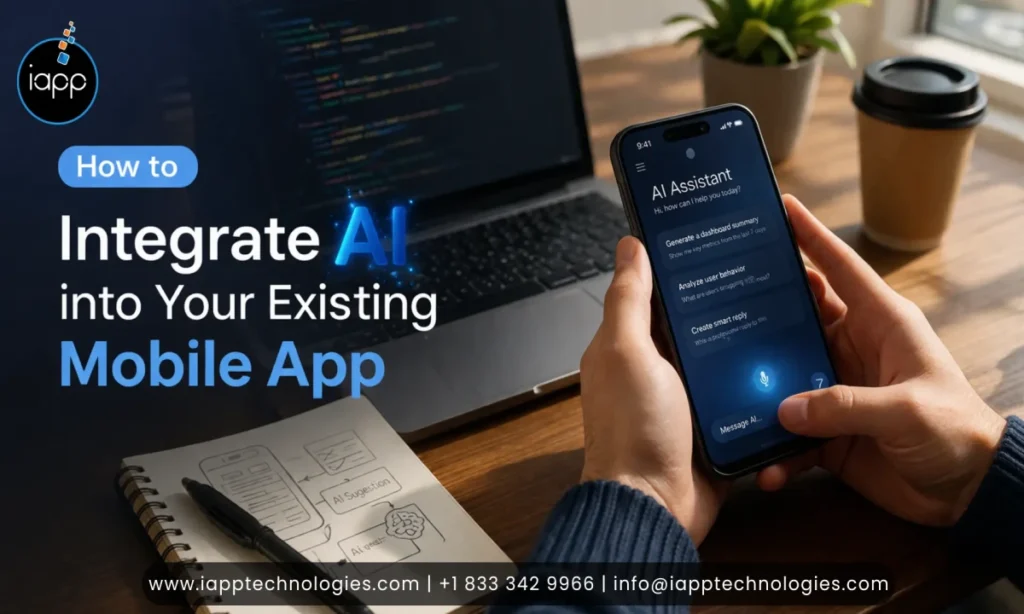
<p>Artificial intelligence is no longer optional it’s a competitive advantage. Businesses across industries are actively integrating AI into their digital products to improve efficiency enhance user experience and drive measurable growth. Mobile apps are becoming smarter and more intuitive with AI powered capabilities.</p>
<p>The good news? You don’t need to build a new app from scratch to leverage AI. If you already have an existing mobile application you can upgrade it with intelligent features using the right approach and technology stack.</p>
<p>With expert guidance from <strong><a href="https://iapptechnologies.com/?utm_source=google&utm_medium=seo&utm_campaign=iApptech" target="_blank">iApp Technologies</a></strong> businesses can seamlessly integrate AI into their apps without disrupting existing performance.</p>
<p>In this blog, we’ll explore how to integrate AI into existing mobile app systems, including use cases, steps and best practices.</p>
<h2>Why Integrate AI into Your Existing Mobile App?</h2>
<p>Integrating <strong>AI</strong> into your mobile app is not just about adding new features it is about transforming how your app interacts with users and handles operations</p>
<p><strong>Personalized User Experience</strong></p>
<p>AI analyzes user behavior preferences and interactions to deliver highly personalized experiences. Whether it’s content recommendations or product suggestions personalization significantly improves engagement and retention</p>
<p><strong>Automation of Repetitive Tasks</strong></p>
<p>AI can automate routine tasks such as customer support notifications and data processing. This reduces manual effort and allows businesses to focus on strategic growth.</p>
<p><strong>Data Driven Decision Making</strong></p>
<p>AI powered analytics help businesses gain insights into user behavior trends and patterns. These insights enable smarter and faster decision making</p>
<p><strong>Improved User Engagement</strong></p>
<p>Features like <strong>chatbots voice assistants</strong> and predictive suggestions keep users engaged and improve overall app performance</p>
<p><strong>Increased Operational Efficiency</strong></p>
<p>AI optimizes backend operations reduces errors and improves overall system performance making your app more efficient and scalable</p>
<h2>Key AI Use Cases for Mobile Apps</h2>
<p>Before integrating AI it’s essential to identify where it will deliver the most value. Many businesses leverage platforms from industry leaders to accelerate implementation and ensure scalability</p>
<p><strong>AI Chatbots and Virtual Assistants</strong></p>
<p>AI chatbots provide instant responses handle customer queries and offer 24/7 support improving customer satisfaction while reducing operational costs</p>
<p>Technologies from OpenAI are widely used to build intelligent conversational experiences in modern mobile apps.</p>
<p><strong>Recommendation Systems</strong></p>
<p>Apps like <strong>eCommerce and OTT platforms</strong> use AI to recommend products or content based on user behavior increasing conversions and engagement</p>
<p>Companies like <strong><a href="https://www.amazon.in/">Amazon</a> </strong>play a major role here with advanced machine learning models that power highly accurate recommendation engines</p>
<p>To build such intelligent systems effectively businesses often rely on <a href="https://iapptechnologies.com/service/ai-development?utm_source=google&utm_medium=seo&utm_campaign=iApptech"><strong>AI development services</strong></a> that ensure scalability and accuracy</p>
<p><strong>Voice Recognition and Commands</strong></p>
<p>Voice enabled features improve accessibility and offer hands free interactions enhancing user convenience</p>
<p>Tools developed by <strong><a href="https://www.google.com/">Google</a></strong> are widely adopted for implementing voice search and speech recognition in mobile applications</p>
<p><strong>Image and Face Recognition</strong></p>
<p>Used in healthcare security and retail apps this feature enables identity verification image search and visual recognition</p>
<p>Platforms like <strong><a href="https://www.ibm.com/in-en">IBM</a></strong> provide advanced computer vision capabilities for secure and scalable implementations</p>
<p><strong>Predictive Analytics</strong></p>
<p>AI predicts user behavior purchase patterns and trends helping businesses make proactive decisions</p>
<p>Cloud based AI solutions from <strong><a href="https://www.microsoft.com/en-in">Microsoft</a></strong> are commonly used to build predictive analytics models for mobile apps.</p>
<p><strong>Fraud Detection and Security</strong></p>
<p>AI identifies suspicious activities in real time making apps more secure especially in fintech and transaction based platforms.</p>
<h2>How to Integrate AI into Existing Mobile App Step by Step</h2>
<p><strong>1. Define Clear Business Goals</strong></p>
<p>Start by identifying what you want to achieve with AI integration. Do you want to improve user engagement automate support or increase conversions? Having clear goals helps you choose the right AI solution</p>
<p><strong>2. Analyze Your Current App Infrastructure</strong></p>
<p>Evaluate your existing app architecture backend systems APIs and scalability. This step ensures your app is ready for AI integration.</p>
<p>If your app needs improvements working with experts in <strong><a href="https://iapptechnologies.com/service/mobile-app-development?utm_source=google&utm_medium=seo&utm_campaign=iApptech">mobile app development</a></strong> can help optimize your infrastructure</p>
<p><strong>3. Choose the Right AI Technology</strong></p>
<p>Select AI technologies based on your requirements:</p>
<ul>
<li>
<p>Machine Learning (ML)</p>
</li>
<li>
<p>Natural Language Processing (NLP)</p>
</li>
<li>
<p>Computer Vision</p>
</li>
</ul>
<p>Choosing the right technology ensures better performance and long term scalability.</p>
<p><strong>4. Data Collection and Preparation</strong></p>
<p>AI systems rely heavily on data. Collect relevant data such as:</p>
<ul>
<li>
<p>User behavior</p>
</li>
<li>
<p>Transaction history</p>
</li>
<li>
<p>Interaction patterns</p>
</li>
</ul>
<p>Ensure your data is clean structured and secure for accurate results</p>
<p><strong>5. Select the Integration Approach</strong></p>
<p>There are two main ways to integrate AI:</p>
<ul>
<li>
<p>Third Party APIs<br />
Faster to implement and cost effective</p>
</li>
<li>
<p>Custom AI Models<br />
More control better customization and scalable</p>
</li>
</ul>
<p>Your choice depends on your business needs and budget</p>
<p><strong>6. Development and Integration</strong></p>
<p>This is where AI features are added to your app. It includes:</p>
<ul>
<li>
<p>Chatbot integration</p>
</li>
<li>
<p>Recommendation engine setup</p>
</li>
<li>
<p>Voice or image recognition</p>
</li>
</ul>
<p>To ensure seamless execution many businesses prefer to <strong><a href="https://iapptechnologies.com/hire-mobile-app-developers?utm_source=google&utm_medium=seo&utm_campaign=iApptech">hire mobile app developers</a></strong> with AI expertise</p>
<p><strong>7. Testing and Quality Assurance</strong></p>
<p>Testing is crucial to ensure AI features work accurately and efficiently. This includes:</p>
<ul>
<li>
<p>Performance testing</p>
</li>
<li>
<p>Accuracy testing</p>
</li>
<li>
<p>User experience testing</p>
</li>
</ul>
<p>Reliable <strong><a href="https://iapptechnologies.com/service/quality-assurance?utm_source=google&utm_medium=seo&utm_campaign=iApptech">quality assurance</a></strong> ensures your app runs smoothly without errors</p>
<p><strong>8. Deployment and Continuous Monitoring</strong></p>
<p>After deployment:</p>
<ul>
<li>
<p>Monitor user engagement</p>
</li>
<li>
<p>Track AI performance</p>
</li>
<li>
<p>Continuously train and improve AI models</p>
</li>
</ul>
<p>AI is not a one time implementation it requires ongoing optimization</p>
<h2>Challenges in AI Integration</h2>
<p>While AI integration offers numerous benefits businesses may face several challenges:</p>
<p><strong>Data Privacy and Security</strong></p>
<p>Handling user data requires strict compliance with data protection regulations</p>
<p><strong>High Initial Investment</strong></p>
<p>Custom AI solutions can require significant upfront investment especially complex applications</p>
<p><strong>Integration Complexity</strong></p>
<p>Older apps may need restructuring to support AI capabilities</p>
<p><strong>Skill Gap</strong></p>
<p>AI integration requires specialized knowledge which may not always be available in the house</p>
<p><strong>Model Accuracy Issues</strong></p>
<p>AI models need continuous training and updates to maintain accuracy</p>
<h2>Best Practices for Successful AI Integration</h2>
<p>To ensure a smooth and effective integration process follow these best practices:</p>
<p><strong>Start with a Clear Use Case</strong></p>
<p>Avoid implementing AI just for the sake of it. Focus on solving real business problems</p>
<p><strong>Focus on User Experience</strong></p>
<p>AI should enhance user experience not complicate it.</p>
<p><strong>Ensure Data Quality</strong></p>
<p>High quality data leads to better AI performance.</p>
<p><strong>Use Scalable Solutions</strong></p>
<p>Choose technologies that can grow with your business.</p>
<p><strong>Monitor and Optimize Continuously</strong></p>
<p>Regular updates and improvements are essential for long term success</p>
<p>For apps targeting multiple platforms adopting <a href="https://iapptechnologies.com/service/hybrid-app-development?utm_source=google&utm_medium=seo&utm_campaign=iApptech"><strong>hybrid app development</strong></a> can simplify AI deployment across devices.</p>
<h2>How iApp Technologies Helps You Integrate AI</h2>
<p>At <strong>iApp Technologies</strong> we specialize in transforming existing mobile apps into intelligent AI powered platforms. Our approach focuses on understanding your business goals and delivering customized solutions that align with your vision.</p>
<p>We ensure seamless integration of AI features without affecting your app’s current performance. From strategy and development to testing and deployment our team provides end to end support</p>
<p><strong>Our Expertise Includes:</strong></p>
<p><strong>1.</strong> AI powered chatbot development</p>
<p><strong>2.</strong> Smart recommendation systems</p>
<p><strong>3.</strong> Predictive analytics solutions</p>
<p><strong>4.</strong> Automation tools</p>
<p><strong>5.</strong> Scalable AI integrations</p>
<p>Whether you’re looking to enhance user engagement automate operations or improve decision making we help you unlock the full potential of <strong>AI</strong>.</p>
<h2>Conclusion</h2>
<p>Integrating AI into your app is easier when you know how to integrate AI into existing mobile app architectures effectively. It not only enhances user experience but also improves efficiency drives engagement and opens new growth opportunities</p>
<p>With the right strategy tools and expert support businesses can successfully transform their apps into intelligent platforms that deliver real value.</p>
<p>Ready to make your mobile app smarter with AI? <strong><a href="https://iapptechnologies.com/contact-us?utm_source=google&utm_medium=seo&utm_campaign=iApptech" target="_blank">Contact iApp Technologies</a></strong> today take the first step toward building a future ready AI powered application.</p>
<h2>FAQs</h2>
<p><strong>How can I integrate AI into my existing mobile app without rebuilding it?</strong><br />
You can integrate AI using APIs or SDKs that connect with your current app allowing you to add features like chatbots or recommendations without starting from scratch</p>
<p><strong>Which AI features deliver the fastest results for mobile apps?</strong><br />
AI chatbots recommendation engines and predictive analytics are the most effective features to quickly improve user engagement and conversions</p>
<p><strong>How much does it cost to add AI to a mobile app?</strong><br />
Costs vary based on complexity API based integration is affordable while custom AI solutions require higher investment but offer better scalability and control</p>
<p><strong>What are the main challenges when integrating AI into an app?</strong><br />
Common challenges include data quality issues integration complexity privacy concerns and the need for continuous model updates</p>
<p><strong>Who should I hire to successfully integrate AI into my app?</strong><br />
You should work with experienced developers or a company like <strong><a href="https://iapptechnologies.com/?utm_source=google&utm_medium=seo&utm_campaign=iApptech" target="_blank">iApp Technologies</a></strong> that can handle AI strategy development and seamless integration</p>
 Jagwinder Singh
Wait! Before you go…
Talk to our experts and turn your ideas into powerful digital solutions.


 Trusted by 1000+ businesses

Fill out the form and our team will get back to you shortly.